Showing posts with label folded chasuble. Show all posts

Friday, 5 November 2010

More on Deacons, and Maniples


More on the subject of Deacons, and more specifically the question "Is a Priest a Deacon?" which has been exercising my mind over the last few days.

I broached this topic with an Anglican clergymen that I met when he was a recently ordained Deacon and who is now a Priest. He said that yes, he was a Deacon. One sign of this is the Priest and Bishop's use of the Maniple, which has its origins in the towel carried by the Deacon. A quick glance at the Catholic Encyclopaedia, which I tend to believe and trust, seems to contradict this, however. The origin of the Maniple is supposedly in a small mappa, or handkerchief which was ornamental and rarely put to actual use, and was carried by anyone of high rank in the left hand. The evidence for this is found in the peculiar use of this vestment by the Bishop who is handed His Maniple to wear at the prayer Indulgentiam in the Mass, while other clergy put theirs on before Mass begins. The Maniple, then, has as its origin a sign of status, rather than service, although the modern Maniple could well be a conflation of the ornamental maniple with other, more practical cloths and towels employed by clergy in the service of the Altar, the Deacon included. Furthermore, along with the development of the Subdiaconate as a Major or higher Order, the Maniple came to be given to the Subdeacon at his ordination, placed on his arm by the Bishop himself, almost as a sign of his inclusion in the higher ranks of clergy. Additionally, the analogous vestment in the Byzantine rite, the epigonation (that hangs from the cincture) belongs only to the Bishop (and there exists an exclusively Papal version in the West). The other possible analogy, the epimanikia, are ornamental cuffs worn by Bishops, Priests and (strict) Deacons.

This is quite a diversion from the actual question "Is a Priest a Deacon?" which the Roman Church logically affirms, since She teaches that Ordination produces an indellible mark on the soul: a diaconal ordination cannot be undone, and diaconal orders are not revoked. It seems to me that a mythology of this gradual acquisition of Orders (indistinct from Office) has been projected onto the Liturgy, which is why Catholics can say a Bishop is Priest, Deacon and Subdeacon when vested in Chasuble, Dalmatic and Tunicle at the Liturgy.

My assertion is that in the West, there has traditionally been a distinction (now lost) between Orders and Office, which comes out in the oldest forms of Ordination rites. The "possession" of certain Vestments by certain Orders is also false, generating an ecclesiastical version of secular "insignia", but probably stems from the idea that as a clergyman ascends through the Orders, he retains their proper Offices and therefore some visible sign of them. If that is true, why do we have Mitred Abbots (who are not in Episcopal Orders) and Deacons and Subdeacons in Folded Chasubles (evidence that the planeta was not originally only a Sacerdotal vestment)?

My feeling is that this conflation of Orders and Offices in the West, and all that comes with it, has been had overwhelmingly negative effect on Western Liturgy: the virtual suppression of the Diaconate, making the Office of Deacon a temporary state from which one will almost invariably proceed to be Priested, and in any case not an important office at all, since all functions can be fulfilled by a Priest; the actual suppression of the Subdiaconate and Minor Orders in our own time (regardless of their antiquity) and, finally, the evolution of the "Server" as an ambiguous category of person occupying the borderland between clergy and laity and therefore quite unregulated and uncontrollable. Given all this, it hardly surprises me when I see Romanized Anglican "Priest-Deacons" forget the rules and kiss the Gospel Book at a Pontifical Liturgy: they simply don't know what they're supposed to be doing, and in most cases, as long as there's incense and pretty vestments, they don't even care.

The first time I opened a Pontifical, I couldn't believe what I was seeing: all the Ceremonies and Rites for instituting and ordaining every category of clergy you would ever need (and some you might think you don't), and blessings for pretty much every eventuality. These rites are effectively dead to most of the Western Church, which is a shameful neglect and rejection of our very anchor in the Faith. When will we learn that we have to let the Sacred Liturgy, that great repository of Tradition, teach us what to do? When will we stop projecting our own superstitious symbolism onto the Liturgy, and hacking away at its integrity with our own confused notions of what is "permissable" or "convenient"? The moment we start constructing the Liturgy (or a Liturgy) around ourselves is the moment when we start making up our own religion, and after that, there's just no point.

Saturday, 3 April 2010

Good Friday in the Older Rite at S. Magnus


The ministers enter the Sanctuary, genuflect and prostrate. Two Acolytes spread an altar cloth on the bare altar and place the missal at the Epistle corner. In the photo above, the Celebrant looks over the reading that is being read by a lector.

After a collect, the Subdeacon chants a reading from Exodus as an Epistle.

The Celebrant sings Christus during the Passion


After the Passion and Gospel, the ministers go to the Altar for the Litanical, or bidding prayers. The intention is introduced by the Celebrant, and the Deacon sings "Let us bend the knee".


After a time kneeling, the Subdeacon sings "Arise" and the Celebrant sings the Collect.


During the Collect for the Conversion of the Jews, an acolyte spreads the carpet and cushion in preparation for the Worship of the Cross.


The Deacon goes to collect the veiled cross from the Altar and brings it to the Celebrant at the Epistle corner.


The Celebrant reveals the right arm of the crufied, and sings "Behold the wood of the cross, whereon the world's salvation was hung", all reply "O come let us worship" and kneel in adoration.

The Celebrant climbs a step, and repeats the above revealing the title board. Finally, he removes the veil entirely before the High Altar. He then places the Cross on a purple cushion (to symbolise Christ's regality) topped with a white veil (to represent His innocence, and His burial shroud) to venerate It.


After this, the Subdeacon and Deacon venerate the cross.


The other ministers come thereafter to venerate, making three double genuflections with prostration as they go. This is what our ancestors in England called "creeping to the Cross".


A relic of the True Cross is prepared also for public veneration.


The relic is venerated by the faithful.

The choir sing the reproaches, recited quietly at the bench.


The Deacon places the Cross on the High Altar


A procession is made to the Altar of Repose, and the Celebrant assumes a white humeral veil.


The procession of the Sacrament back from the altar is the first part of the Mass of the Pre-sanctified.


Here, the celebrant is seen censing the Elements. He has prepared a chalice of unconsecrated wine which also stands on the corporal. The Eucharist is censed, as is the altar but the Celebrant is not. He then says the Pray Brethren, not turning all the way, sings the Libera nos, performs the fraction and with some Communion devotions, receives the Host consecrated at Yesterday's Mass.


In deference to Local Custom, the faithful also receive Communion from a number of Hosts reserved with the Priest's Host.


There being no other ceremonies, the ministers stand to sing "When I survey the wondrous Cross" before retiring to the Sacristy.

The ministers in the Sanctuary after the Liturgy

Monday, 29 March 2010

Exclusive Preview of Black Folded Chasubles


It is my pleasure to present the new set of Black folded chasubles for Good Friday made by Nick Sargent at S. Magnus the Martyr for this Holy Week. As you can see in the above photograph, we had decided to go for the Spanish cut of chasuble, and to fold them at the breast as one would a Roman chasuble. These are certainly the only Spanish-cut folded chasubles I have ever seen, most certainly unique in London and possibly in the UK.

This shot from the back shows the exquisite shape from the back, plus the effect given by the uniform single orphrey at the back. The contrast between the fine pattern of flowers on the chasuble fabric and the large, round cross-based motif is very pleasing. But these are not fussy vestments that distract the eye. Rather, they beautify the liturgy and contribute to a sense of solemnity which is entirely appropriate to Good Friday.

The orphrey fabric came from Damascus, from a supplier on Straight Street which has long had a friendly relationship with S. Magnus. Our purple High Mass set with dalmatics also features fabric from this shop. The orphrey pattern for this set features an anchor amidst circular crosses, a sign of hope for those who chose to discern it in the Passion which these vestments recall.


Here I am posing as a Deacon, although I think I can get away with it since it's just a photo-op. The broad stole features a band of the same purple as used on the maniples. The broad stole is also designed to cross over at the bottom to form the sort of "fish-tail" effect seen in other examples of the broad stole.


Palm Sunday in the pre-Pian rite


With no disrepect intended to the Venerable Pius XII, the Holy Week reforms that became effective during his pontificate truly make a dog's breakfast of the most important week in the liturgical year. I didn't quite realise how true that was until yesterday, when I assisted at a pre-Pian Palm Sunday for the first time, and realised why so many choose to cleave to this excellent tradition of liturgy. Not everyone will be familiar with the old-Old Rite rites, so I will try to describe the photos I have shared.

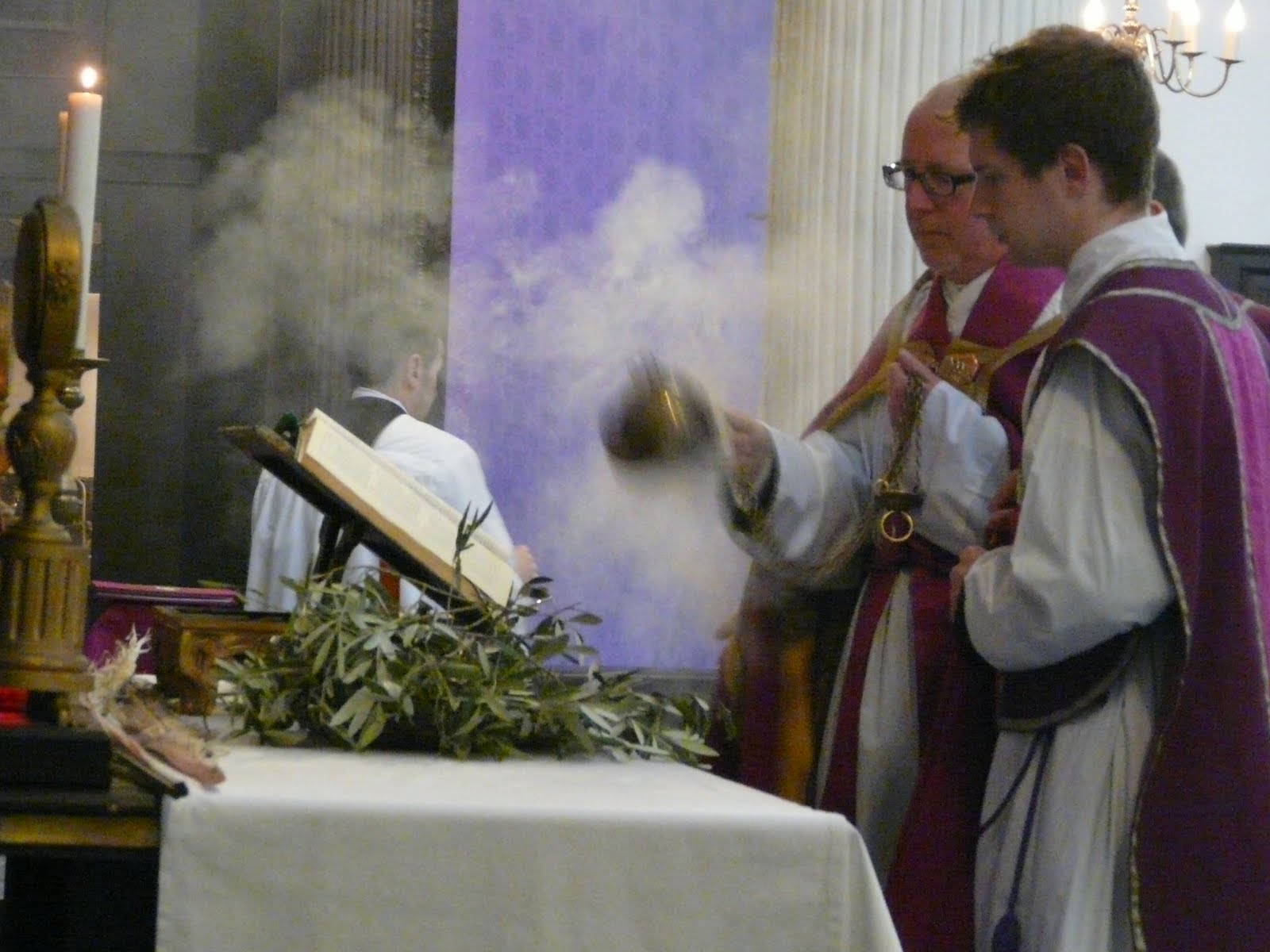
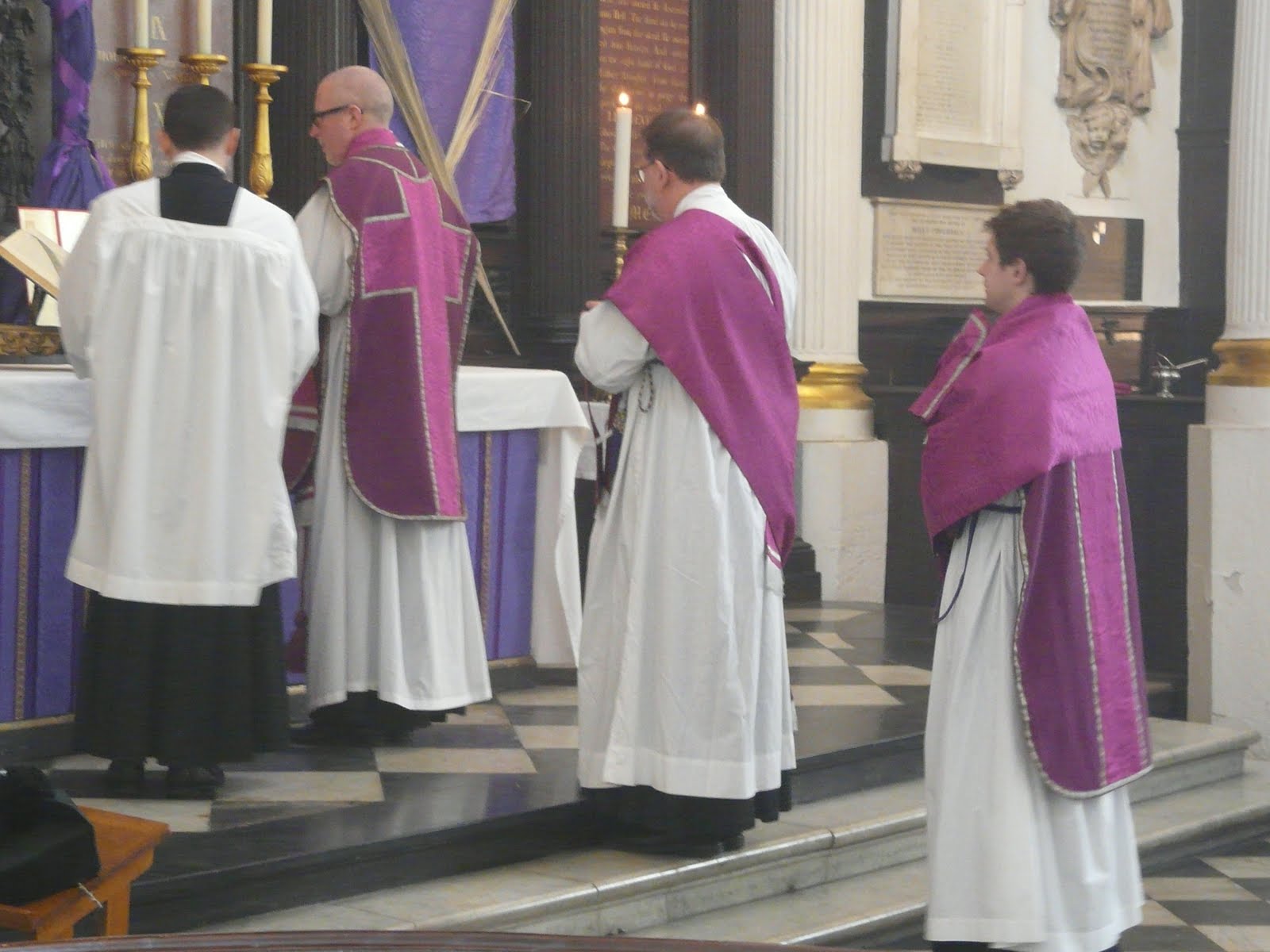
The blessing of the palms takes place within a ceremony that has the form of a little Mass, with its own Liturgy of the Word, Collects, Preface, Sanctus, and "Canon" of Blessing. This imitation-Mass clearly links the entrance to Jerusalem with the Passion that follows (in the Mass of the day). The vestments worn are folded chasubles for the Deacon and Subdeacon, and a cope for the Celebrant. The blessing and Mass both use purple, unlike the reformed rite instituted by Pius XII, and God only knows what happens in the Modern Roman Rite! In this picture the ministers arrive at the altar and move to the Epistle side.

Hosannah, Son of David is the Antiphon that corresponds to the Introit of a Mass, and at Oremus of the Collect, the Subdeacon goes to his place and removes his folded chasuble, before going to sing the Lesson from Exodus at the appointed place.

There is also a Gospel proper to the blessing, which recounts the entrance of Christ to the city. For this, the Deacon wears his broad stole as he would at Mass. The Celebrant is listening from the Epistle side, because the Missal has not been moved from the place of the Palms.


The Celebrant kisses the book and is censed as at Mass.

A preface follows, then a "canon" of five blessing prayers is said over branches of Olive and Palm.


The branches are lustrated and censed.

An assistant priest hands a palm to the Celebrant, and the ministers receive theirs kneeling.

Palms are then distributed to the faithful


The procession forms and leaves the church


The Subdeacon carries the veiled cross


When the procession arrives back at the church, two cantors remain inside and shut the doors. From inside they sing "all honour, laud and glory" which is repeated by those outside. After this dialogue, the Subdeacon strikes the door of the church thrice with the foot of the cross....


And the procession enters the church to the chanting of another Antiphon Ingredientem. As a side-bar, the piety of the women who chose to wear a Mantilla or a hat on this day is to be praised.


Mass proceeds as normal with the rules for Passiontide, except for the Chanting of the Passion, after which the end of the Passion is chanted as a normal Gospel, with incense (and acolytes but no lights) thereafter. Unfortunately I couldn't load the picture of the Celebrant, chanting the Passion as Christus at the Gospel side, while the narrator Chanted from the lectern.
This liturgy affected me in ways I didn't know it would. The sense of event which followed the first collect and reading, so familiar yet so different really caught my imagination. The silent, pregnant pause between the end of the Passion sung but the narrator, and the bit sung as the Gospel was truly dramatic and affecting. I have read that this climatic moment represents the desolation of the Church at the events described in the Passion. Even the slight pause that I made to genuflect while singing "and at the name of Christ...every knee shall bend" in the Epistle seemed appropriate, all leading up to the Great Event of the Eucharistic Sacrifice. I have rarely felt so free to engage with the Sacrifice as I did yesterday having heard the Passion sung. Hopefully I'll have time to post photos from the Triduum later this week. Stand by for a preview of our Good Friday vestments.


Wednesday, 27 January 2010

The Language of the Liturgy : Candlemas


The often disregarded reforms in the Roman liturgy which took place before the Second Vatican Council and the new Missal of Paul VI were largely kind to the Feast of the Purification, but the changes which were introduced were not insignificant in their ramifications. Regional variations of the Roman rite are often referred to as “dialects” of the same “language”, and in my own view, one fruitful way in which to approach the Liturgy is by analogy to language. Like any spoken language, the Roman rite employs a rich vocabulary, some of which will have “cognates” in other rites, some of which will be unique. The beauty of the eloquent use of a natural language is often associated with its ability to evoke other speech acts, words or expression over time and between places, the inter-dependence of different instances of language from which it derives its complexity and its refinement. The same is true of the liturgy.

The reforms of the Roman liturgy during the 20th century, then, can be seen as a sort of editing process. The kindest, most elegant type of liturgical reform throughout history has been termed “organic”, just like the “organic” development of languages. This type of reform isn’t really reform at all, but more properly the “form” of something that is by definition able to adapt and change from within, without need of poking or pruning from outside. The reforms of the 20th century have largely been of of a much more severe type; an extreme editing process that disrupts the meaning of something and alters it almost beyond recognition. A useful analogy would be to imagine the process of editing Martin Luther King’s “I have a dream…” speech. Imagine if the editor decided that the repetition of the phrase “I have a dream” was unnecessary and probably bored the people listening to it. With keenness, he preserves the phrase “the sweltering summer of the Negro’s legitimate discontent” but dispenses with all phrases that start with “I have a dream” or else takes parts of them and moves them to the beginning of the speech. Imagine if this new, edited form of the speech became the official version to be taught in school and reproduced in encyclopaedias, such that the old form only existed in original recordings closely guarded by collectors. What remains is still wonderful oratory, but is it the same, full-blooded speech which planted itself in the hearts of a nation, and set them on fire with a yearning for justice?

The ceremony of the Blessing of Candles and Procession before Mass on the Feast of the Purification of the Blessed Virgin Mary is for many one of the highlights of the liturgical year. The Nunc Dimittis with its antiphon “A light to lighten the Gentiles…” forms the liturgical backbone of this rite, and the theme of Simeon’s acclamation in the temple on seeing the Christ child runs through all the collects which traditionally accompany the blessing of the candles. The distribution of candles to the faithful has a symbolism which is both obvious and powerful, readily understood but replete with meanings which unfold in the prayerful heart of the believer. The form of ceremony that survived into the late fifties also possessed certain meanings, explicit and implicit, which were lost in the reformed rite. A brief comparison follows :

For a High Mass of the Feast of the Purification, the colour of the blessing and procession is violet and the Mass is sung in white. The meanings of the colour violet in the Roman rite are many and varied, but include such things as “not-yet-redeemed” or “awaiting the Messiah” (Advent and Lent, or indeed the Votive Mass pro pace). The colour takes us back to the time before the work of Calvary is complete, and the alternation between violet and white in the liturgical year reflects the gradual revelation of Christ to the world, the story of which is told in the Gospels from Advent to Easter. Before the ceremonies begin, the Altar is veiled in violet and unornamented. The pieces of liturgical furniture, the credence, the Mass vestments on the sedilia and even the candles to be blessed are all hidden under violet veilings. The sacred ministers enter, the celebrant in cope and the deacon and subdeacon in their violet folded chasubles. The origin of the folded chasuble, as has been discussed elsewhere, is obscure, but evidence points to the custom of deacons and subdeacons adopting the chasuble (and folding it up) for penitential processions, which is why they continue to be worn on ember days of Lent and Advent, and for the procession on Candlemas. The Celebrant kisses the Altar (but the other ministers don’t genuflect when he does so) and then the three line up at the Epistle Side for the blessing of the candles. The five prayers of the blessing speak of the light of Christ and the petition of Simeon, but mention also the work of bees and the pure oil burnt in the tabernacle. The candles are censed and lustrated, while the celebrant says the antiphon Asperges Me (without the psalm). The content of the prayers moves from an emphasis on Christ as light to the collective and the external (Israel, Gentiles, people, arms of Simeom) to the light and purification of the individual and his soul (“may not be wanting to our souls”, “purge me”). The Candles are distributed while the Nunc Dimittis is sung. There is a final collect which underlines the work of Christ on the soul through outward devotion (a good précis of the five blessing prayers), before which (if it be not a Sunday and after Septuagesima) the Deacon and Subdeacon sing Flectamus genua and Levate respectively. These instructions from the sacred ministers to kneel in prayer and arise before the collect is sung also feature in the liturgy of Good Friday and on the Ember Days. The procession is then made, with the Subdeacon as cross-bearer and the Antiphon “Adorna thalamum tuum, Sion” by S. John of Damascus is sung, incidentally one of the few borrowings of text and music by the Roman Church from the Greeks. At the entrance to the church, or return to the sanctuary if the procession has not left the church, a responsary is sung V. They offered for him unto the Lord a pair of turtle doves or two young pigeons. As it is written in the law of the Lord R. When the days of Mary’s purification according to the law of Moses were accomplished, they brought Jesus to Jerusalem to present him to the Lord. As it is written in the law of the Lord. As the Catholic encyclopaedia notes :

“The solemn procession represents the entry of Christ, who is the Light of the World, into the Temple of Jerusalem. It forms an essential part of the liturgical services of the day, and must be held in every parochial church where the required ministers can be had. The procession is always kept on 2 February even when the office and Mass of the feast is transferred to 3 February.”

Indeed, owing to the presence of the processional cross as a symbol of Christ, this act of entrance is the ritual re-enactment of the presentation itself, and as such forms the climax of this ceremony. During the procession, the Altar has been unveiled to reveal a white frontal, ready to greet the Lord. Without further ceremony, the Mass proceeds. The ministers assume white Mass vestments (the tunicle and dalmatic underlining the move into new light and joy) and the prayers at the foot of the altar are said. The Candles of the faithful are to be lit to greet Christ in the Gospel and From the Te Igitur to after the Communion.

As I mentioned, the Missal of 1962 has been largely kind to this ancient rite, preserving much of the form. However, there are some important changes which disturb and deform the original rite. Firstly the entire ceremony of blessing is said in the White Mass vestments. The entire “before redemption” meaning of the colour violet, which is (inconsistently) maintained in Advent and Lent to the present day, despite the suppression of the folded chasuble, is lost. Related to this, the instructions Flectamus genua and Levate are gone. These instructions particular to the Deacon and Subdeacon were also part of the Solemn prayers of pre-1955 Good Friday, but for no apparent reason, the Subdeacon was divested of his Levate, which was given to the Deacon.

Secondly, and consistent with a general move to suppress these prayers where another rite precedes Mass (viz. the 1955 Palm Sunday [though previous to this reform, the psalm was omitted as per Sundays in Passiontide]), the prayers at the foot of the altar are not said. While much could be said about the disregard shown in this reform for the liturgical coherence of the Mass, and the importance of the words “Introibo ad altare Dei” in the worship of the Church, I only have time here to share these words again from the Catholic Encyclopaedia :

"That the Mass, around which such complicated rules have grown, is the central feature of the Catholic religion hardly needs to be said, During the Reformation and always the Mass has been the test. The word of the Reformers: "It is the Mass that matters", was true. The Cornish insurgents in 1549 rose against the new religion, and expressed their whole cause in their demand to have the Prayer-book Communion Service taken away and the old Mass restored. The long persecution of Catholics in England took the practical form of laws chiefly against saying Mass; for centuries the occupant of the English throne was obliged to manifest his Protestantism, not by a general denial of the whole system of Catholic dogma but by a formal repudiation of the doctrine of Transubstantiation and of the Mass."

To my mind, the decision to remove in one stroke, a part of what is and has been for centuries, words that have become ingrained in the mind of every Catholic, is a serious assault on tradition, and, by extention, what that tradition seeks to protect, and this assault must be interrogated. The notion that a part of the ancient practice of the Church’s regular worship can be edited out, simply for the sake of convenience, is above all patronising to the very people for whom this service exists: the plebs sancta Dei. The assumption that the lay man or woman in the nave of the church has suffered, Sunday by Sunday, from a lack of comprehension, an inability to engage with the rite of Mass because of its convoluted ceremonial or its long-dead Latin is the great fallacy of the movement for reform, and a damaging lie. The simplification and reduction of the liturgy is, in my view, the very reason why church attendance has dropped so severely since the period of reform began. As one friend put it, when a churched Christian reaches adulthood and is still expected to engage with a dumbed-down liturgy that was altered to be accessible even to small children, then what really is there to keep them from leaving? An examination of the unreformed rites of Candlemas, as with any ancient ceremony of the Church, clearly exhibit a language in vibrant use, a language which can be heard readily by anyone who opens themselves to it. The particular language is the Roman rite, but the message is redemption. Dumbing down the Mass, the Liturgy, the traditions of the Church, can only indicate that much of the Church as a whole has stopped believing in Herself, and that what She has offered to Her children for centuries is no longer worth very much at all.

Sunday, 6 December 2009

Advent II


Here are one or two photos from the Mass of Advent II on Sunday.


The Asperges collect


The censing of the altar at the introit

Censing of the celebrant

The Gospel is proclaimed in the body of the church

During the Canon. As you can see, the Deacon wears a 'broad stole', representative of his folded chasuble worn over the shoulder, while he fulfills his diaconal duties at the altar.

Friday, 30 October 2009

Back to the Fold!


It’s almost inconceivable that there are still people who haven’t heard the biggest news story in the Anglican Communion in recent years, but just in case anyone missed it: St. Magnus the Martyr, London Bridge will be re-introducing the folded chasuble, or planeta plicata, for its Advent liturgies this year. Already I can hear gasps and whispers (and snarls from across the Thames) at this supposed liturgical innovation, but let me assure readers that it has been our custom at S. Magnus since time immemorial (allowing for a few extended black outs between the pontificates of Popes Clement VII and Benedict XVI) to vest the Deacon and Subdeacon at High Mass in the folded chasuble during penitential seasons such as Lent and Advent.

Perhaps because the original reason and method for folding chasubles became so obscure, the folded chasuble was the unfortunate victim of reforms to the Roman Rite of 1962 and fell entirely out of use. Largely seen as a curio to be hunted in the sacristies of great churches, the folded chasuble is now almost exclusively seen in use only at certain Anglican shrines such as S. Clement’s Philadelphia. This is largely because Pope Benedict’s motu proprio liberalising the celebration of Mass in the usus antiquior specifies that the 1962 Missal, being the last “Tridentine” Missal, should be used, along with its rubrics and instructions. However, many Anglicans of the “Missal school” have come to regard the 1958 English Missal as the last authentic expression of Tridentine liturgy in the Anglican tradition, and as such maintain certain customs and usages which were lost in later Roman Missals.

So it is my pleasure to announce that, God willing, the folded chasuble will once again be seen in S. Magnus, as an expression of our desire to continue the authentic traditions of our Fathers in the Catholic movement; as a sign of our commitment to offering the Liturgy of our predecessors, and for Advent, to express the penitential nature of that season in vivid liturgical vocabulary.

For more on the folded chasuble, click here.

This post is also an open invitation to people interested in serving at S. Magnus. We occasionally borrow servers for big events, but like most churches, we generally get by on a small but dedicated serving team, who nonetheless have other commitments and leave us short. If you live in London and think you might want to serve at S. Magnus, please contact us. This year we have been able to offer a High Mass on many Sundays, and hopefully we will be able to do so in Advent and Christmas. Still, we need people with expertise and an interest in traditional liturgy to help make our celebrations run smoother. Be assured you would not be trained in the idiosyncrasies of some “High Church”, but rather you would be serving THE Mass of Ages.