Showing posts with label s. magnus. Show all posts

Saturday, 4 June 2011

The Vigil of Pentecost

The Vigil of Pentecost will be celebrated in the Church of S. Magnus on Saturday 11th June at 6.30pm. This vigil, supressed in the devastating 1955 Holy Week reforms, is now almost never celebrated, and I am informed that if we manage to find Deacon and Subdeacon for our celebration at S. Magnus, it will likely be the first such celebration in this country since the vigil was supressed.

Gregory DiPippo's excellent Compendium of the Holy Week reforms, published on the New Liturgical Movement blog, includes a description of this Vigil, to which I can add little.

Synopsis of the Pre-Pius XII Ritual

Already in very ancient times, the sacrament of baptism was celebrated on the feast of Pentecost as on Easter; this is said explicitly by Pope Saint Siricius (384-399) in a letter to bishop Himerius of Tarragon. (Epist. ad Himerium cap. 2 : Patrologia Latina vol. XIII, col. 1131B-1148A) Pope Saint Leo I (440-461) reasserts that this was the practice of the Church in a letter to the bishops of Sicily, exhorting them to follow the example of the Apostle Peter, who baptized three thousand persons on Pentecost day. (Epist. XVI ad universos episcopos per Siciliam constitutos : P.L. LIV col. 695B-704A) This custom is expressed in the liturgy of the vigil of Pentecost, which resembles in many respects the rite of Holy Saturday. This resemblance is found in the Missal of St. Pius V, as in all of the missals that came before it, and in the medieval usages of the great cathedrals and religious orders.

The rite begins in the penitential color, violet. There is no blessing of a Paschal fire, nor of a Paschal candle, nor the Exsultet; therefore, the vigil begins with six prophecies, repeated from the vigil of Easter, each of which is followed by a prayer. (The three tracts from Easter night are also repeated in their respective places). The six prayers are different from those of the Easter vigil, but express in many respects the same ideas. After the sixth prophecy, the blessing of the baptismal font is repeated, changing only the prayer at the beginning, following which the Litany is sung. During the Litany, the major ministers return to the sacristy and change to red vestments for the Mass.

Other rites of the Easter vigil are repeated at this vigil Mass; there is no Introit, and the bells are rung at the Gloria in excelsis. (The Introit Cum sanctificatus fuero was later assigned for private Masses only.) The collect of the Mass refers to the baptismal character of this celebration even more clearly than that of the Easter vigil Mass. After the Alleluja of the Mass is sung the same Tract which is sung on Easter night. At the Gospel, the acolytes do not carry candles. Just as on Easter night the Resurrection is watched for, but not anticipated, so also with this same gesture, the Church watches for the coming of the Holy Spirit in tongues of fire, as Christ told His disciples to do, but does not anticipate it. A further reference to the baptisms done in the first part of the rite is found in the Canon of the Mass, in which the proper Hanc igitur of Easter is said. This text speaks explicitly of those whom the Lord “(has) deigned to regenerate of water and the Holy Spirit, granting to them remission of their sins. ” It is said in this Mass, and though the entire octave of Pentecost, as it is also said at the Mass of the Easter vigil, and throughout the octave.


Synopsis of the Pius XII Reforms

The 1955 reform almost completely removes this ancient tradition of the Roman Rite, suppressing the Prophecies, the blessing of the font, and the Litany. The Mass begins with the Introit which was formerly said only in private Masses. The rubrics about ringing the bells during the Gloria and not carrying candles at the Gospel are also suppressed. The text of the Mass itself is not changed; the same collect and the same Easter Hanc igitur are still said, although the baptismal rituals to which they refer are suppressed.
Copyright Gregory DiPippo 2009

So I'd urge you come to S. Magnus to take part in this most ancient and excellent preparation for the Great Feast of Pentecost. I don't know that another Church in London will be celebrating the vigil and although we hope to repeat it next year, God willing, this could be your one chance to attend this service. See you there!

Tuesday, 8 June 2010

The seeds of its own dissolution?


I'm currently reading Fr Colin Stephenson's amusing memoir Merrily on High, a very interesting first-hand account of some of the churches I know and love in the glory days of Anglo-Catholicism. I'm only about half way through, but one thought which Fr Stephenson repeats at various junctures of his story deserves comment and interrogation.

From the beginning of his testimony, Fr Stephenson asserts that the strain of Anglo-Catholics who threw their lot in with the "Baroque Catholicism of the Continent" were really dooming themselves to failure, as the fruits of the Liturgical Movement (perceived by Fr. Colin as intrinsically a good thing) percolated into the stuffy mainstream of Western Catholicism.

At points he recalls individuals whom he accuses, and I'm sure not erroneously, of adopting Papalism or Ultramontanism as a foil for inflicting their own whims on their congregations and communities. There is one passage in the book which typifies this opinion:

"Yet for all its [Anglo-Catholicism's] triumphalism it held within it the seeds of its own dissolution which the disorganisation of the last war simply accelerated. It had become congregationalist and cut off from the main stream of the Church of England and rejoiced to have it so. It had thrown in its lot devotionally with the baroque Catholicism of the continent just when that movement was about to be discredited in the church of its origin, and looking back at it now one realises that it had about as much chance of appealing to the average Anglican as the Folies Bergeres to the Mother's Union."

There are also frequent digs at "fussiness" in the Liturgical and Devotional aspects of the movement in the 20s and 30s :

"'It's not a sermon you have [at St Bart's, Brighton] but an interval while the wind performers empty their instruments'. Some months ago I should not have thought this funny, but now I could see the point and as I was leaving he said. 'Our High Mass is always over within the hour'." p66

"I did not see him [Fr Kenrick] often after this pilgrimage, which is recorded in his memorial in Holy Trinity, Hoxton, but I did once visit him there on a Sunday and was surprised to find only a handful of people at High Mass. I was still at the stage when I honestly thought that the externals of Catholic worship were bound to attract crowds. Mature experience has taught me that they are far more likely to drive them away!" p.69

..a reflective passage towards the end of the book...

"[Mount Athos] did reveal to me very clearly the dangers of trying to shut the Church up in the past. So much of the Catholic Movement in the Church of England has been a turning backwards and a holding on to certain positions with a fanaticism bred from a sense of insecurity." p186

"... the new Roman instructions for the rites of Holy Week laid down that on Good Friday the cross, if wished, could simply be held up for people to venerate in their places. When Duncan-Jones did this twenty years earlier in Chichester Cathedral he was the laughing stock of the whole Anglo-Catholic world." p. 77

It is difficult to isolate passages of the book which articulate in full Fr. Stephenson's retrospective critique of the fussiness, extremism and punctiliousness of the Anglo-Catholicism of his youth, but I hope you get a general idea of the argument, which could be summarised as follows: Some of the more Romanised Anglo-Catholics were only attracted to the movement for its colour and exoticism and had no interest in an authentic Catholicism (strangely never fully expounded in this memoir, whereas the "externals" are). The truest Anglo-Catholicism found its expression in the Reformed religion adopted later on in the Roman Catholic Church under its greatest hero-Pope John XXIII, which became far more palatable to Anglicans in general and has proved itself over time."

This retrospective criticism of the Anglo-Catholicism is common among the generation who grew up in its Golden Era, and who subsequently had to mourn its passing, and then took charge of the the introduction of the New Catholicism into the mainstream of the CofE. It is also the heritage of that generation of priests who were taught by Fr Stephenson's generation, and who knew him at Walsingham as youngsters, the same exuberant generation of fallen Catholics at places like Staggers, before Ena the Cruel put an end to their shennanigans; a generation that simultaneously revels in the old party badges of lace, birettas, continental vestments and baroque fittings, while owing complete allegiance to the Reformed Roman Liturgy and a vague notion of Papalism. There is a dreadful schizophrenia among these two generations of Anglo-Catholic clergy. The glory days were brilliant, but there is bitterness stemming from the fact that the movement failed to deliver on its promises. They do not know how to deal with the fact that while the Liturgical Movement and its most radical reforms in some ways signalled the death of Anglo-Papalism, Anglican Ultramontanism and Romanism as lively forces in the Anglican Communion, the subsequent Reformation and Iconoclasm of Western Catholicism turned out to yield a far more importable fruit the heady ecumenical decades of the 70s and 80s, apparently giving Papalist clergy what they'd wanted all along : a vernacular Eucharistic liturgy, expressed in the ASB and CW texts.

I have two main objections to this point of view. Firstly, there is an unhealthy distinction between the "externals" of worship and the "interiority" of the faith, with the assumption that those who cherished the externals spurned the Faith itself. Secondly, the attitude that Papalism has proven to be the magic ingredient that has kept the small flame of Anglo-Catholicism alive into the present day, and that it continues to be the guiding light of the movement.

On the both points, I concede that the Romanised Anglo-Catholic dependence on Ultramontanism for its self-expression was the reason for its dramatic death in the 1960s, as the "old ways" were markedly changed (at least inasmuch as the faithful perceived this "radical" change) and old certainties were eroded. However, I would also like to suggest that the reason why some of the most "extreme" and "fussy" Romanised Anglicans enjoyed any degree of success, and I have no hang ups in including the wealthy, largely White Anglo-Saxon congregations of places like S. Magnus (it its day) along with the famous but over-fetishised Slum Parishes (like Hoxton); is not so much because they espoused extreme liturgical Romanism and Ultramontanism, but because these places offered the fullness of the Sacraments, the fullness of the Liturgy, the rootedness in something authentically ancient and identifiably so, a true living School of the Faith. The Ultramontanism of these Parishes was certainly one factor in their decline; but their subsequent side-stepping of Vatican liturgical regulation in favour of asserting their own autonomy in matters liturgical under the authority of tradition is part of the secret of their survival. I have been to English Missal Masses at Hoxton (ergo not a strict 1962 celebration!), but I know far more about S. Magnus, where after years of increasing isolation and a liturgical regime of slack modernism, the Old Rite is flourishing and managing to find its feet again. We have learnt the lesson that good liturgy needs no special dispensation from the Holy Father, to whatever degree we accept his Spiritual Jurisdiction here in our little corner of the Anglican Communion. The prospect of an Anglican Ordinariate full of Anglican clergy bowed down under Roman liturgical law and so using the modern Roman Missal and the "liturgical Bonsai" that is the 1962 rite, has brought our cherished freedom into even sharper relief, despite our perilous position in the wider Communion. These days are for us an opportunity to explore that tradition, and I personally am coming to realise that the "fussiness" denounced by the Colin Stephenson generation is actually the beginning of a spiritual revival for our little group (small, but outward looking, intimate but not exclusive), where all around us is death and division.

Moreover, I hope we can steer clear of the label "traditionalist", which is bandied around so often by Forward in Faith circles, as if we were the same movement that in the Roman church cherishes the heritage of the Liturgical Movement and its "saints" Bugnini and Pio XII, abhorrs Vatican II and exalts Papal Authority. We are rather the "orthodox", who value the genuine authority of tradition, without wanting to go around harrassing gay rights activists and abortion doctors with it.

The new generation of orthodox Anglican seminarians, as well as their established faithful, are entering an era where the issue is no longer "Women Bishops", but whether or not to take the leap into the Roman Jurisdiction. They will need to decide how to live out the faith, or to pick up Stephenson's terms, which "externals" to adopt, in this new and uncertain territory, both inside the ordinariate and outside it. Is the only future for orthodox Anglicans under Roman authority? Is the alternative to submission complete division into various laity-lite bodies calling themselves "Anglican"? Is it possible that the Ordinariate will close the book on Anglican Ultramontanism? What and who will be left behind? I wonder if we're onto an answer....

Monday, 31 May 2010

End of Our Lady's month of May


Today many Catholic Anglicans will be risking their linen suits on the National Pilgrimage to Walsingham. I really wish that I could go at least once in life, if only for the pilgrimage Mass on the site of the old Abbey. One year.

Well, I thought I would share with readers how I'm marking the last day of Mary's month of May. The picture above is of my home altar. This is not an altar, as people sometimes imagine from the name, where Mass can be said. Rather a "home altar" is a wonderful Catholic tradition which creates a focus of prayer and reflection within the home; a place where one can express personal and religious creativity. It is an altar in the sense that the experience of the Sacred goes in both directions. On the one hand it is a "dwelling place" of Holiness, where God's glory is told in images of His Saints and in the Crucifix. On the other hand, it is the place where "sacrifices" of prayer are made, represented by material offerings of flowers, oil lamps, candles and incense.

My home altar started life as a St. Joseph's altar to celebrate my name day, but it has survived through year and has been reconfigured monthly. The altar is three-tiered to represent the Holy Trinity and the Holy Family. The principal image of the month is displayed on the top tier, this month is it Our Lady of Candelaria. In front of Her on the tier below are three small oil lamps, two of which burn for specific intentions, the central one is kept lit whenever I am at home. Beside the lamps are two metallic icons from the Holy Land reflecting the principal patronage of Our Lady and S. George, and which remind me to pray for peace in the Middle East. The tier below features images of my other patrons, S. Joseph, S. Gerard, S. Magnus, each one reminding me to pray for specific intentions, for my parish and for pregnant women or new mothers. The right hand corner of this tier is dedicated to prayer for the dead, and besides a picture of a deceased relative, normally features a book of prayers for the Suffering Souls. The left hand side of this tier reminds me of spiritual discipline. It is where I keep my rosary (from the shrine of Our Lady of Walsingham) and recently features an image of whichever Saint I am remembering who isn't the principle Saint of the month. In this case I'm remembering to thank Venerable Jose Gregorio Hernandez (a Venezuelan doctor who died in 1919 and was beatified in 1949), for prayers for recovery from a recent illness.

Anyway, I hope my little home altar encourages other people to take up the tradition. For some tips and more information check out this article on the Domestic Church, which gives some good background and ideas for bringing holiness into the home.

Monday, 29 March 2010

Exclusive Preview of Black Folded Chasubles


It is my pleasure to present the new set of Black folded chasubles for Good Friday made by Nick Sargent at S. Magnus the Martyr for this Holy Week. As you can see in the above photograph, we had decided to go for the Spanish cut of chasuble, and to fold them at the breast as one would a Roman chasuble. These are certainly the only Spanish-cut folded chasubles I have ever seen, most certainly unique in London and possibly in the UK.

This shot from the back shows the exquisite shape from the back, plus the effect given by the uniform single orphrey at the back. The contrast between the fine pattern of flowers on the chasuble fabric and the large, round cross-based motif is very pleasing. But these are not fussy vestments that distract the eye. Rather, they beautify the liturgy and contribute to a sense of solemnity which is entirely appropriate to Good Friday.

The orphrey fabric came from Damascus, from a supplier on Straight Street which has long had a friendly relationship with S. Magnus. Our purple High Mass set with dalmatics also features fabric from this shop. The orphrey pattern for this set features an anchor amidst circular crosses, a sign of hope for those who chose to discern it in the Passion which these vestments recall.


Here I am posing as a Deacon, although I think I can get away with it since it's just a photo-op. The broad stole features a band of the same purple as used on the maniples. The broad stole is also designed to cross over at the bottom to form the sort of "fish-tail" effect seen in other examples of the broad stole.


Palm Sunday in the pre-Pian rite


With no disrepect intended to the Venerable Pius XII, the Holy Week reforms that became effective during his pontificate truly make a dog's breakfast of the most important week in the liturgical year. I didn't quite realise how true that was until yesterday, when I assisted at a pre-Pian Palm Sunday for the first time, and realised why so many choose to cleave to this excellent tradition of liturgy. Not everyone will be familiar with the old-Old Rite rites, so I will try to describe the photos I have shared.

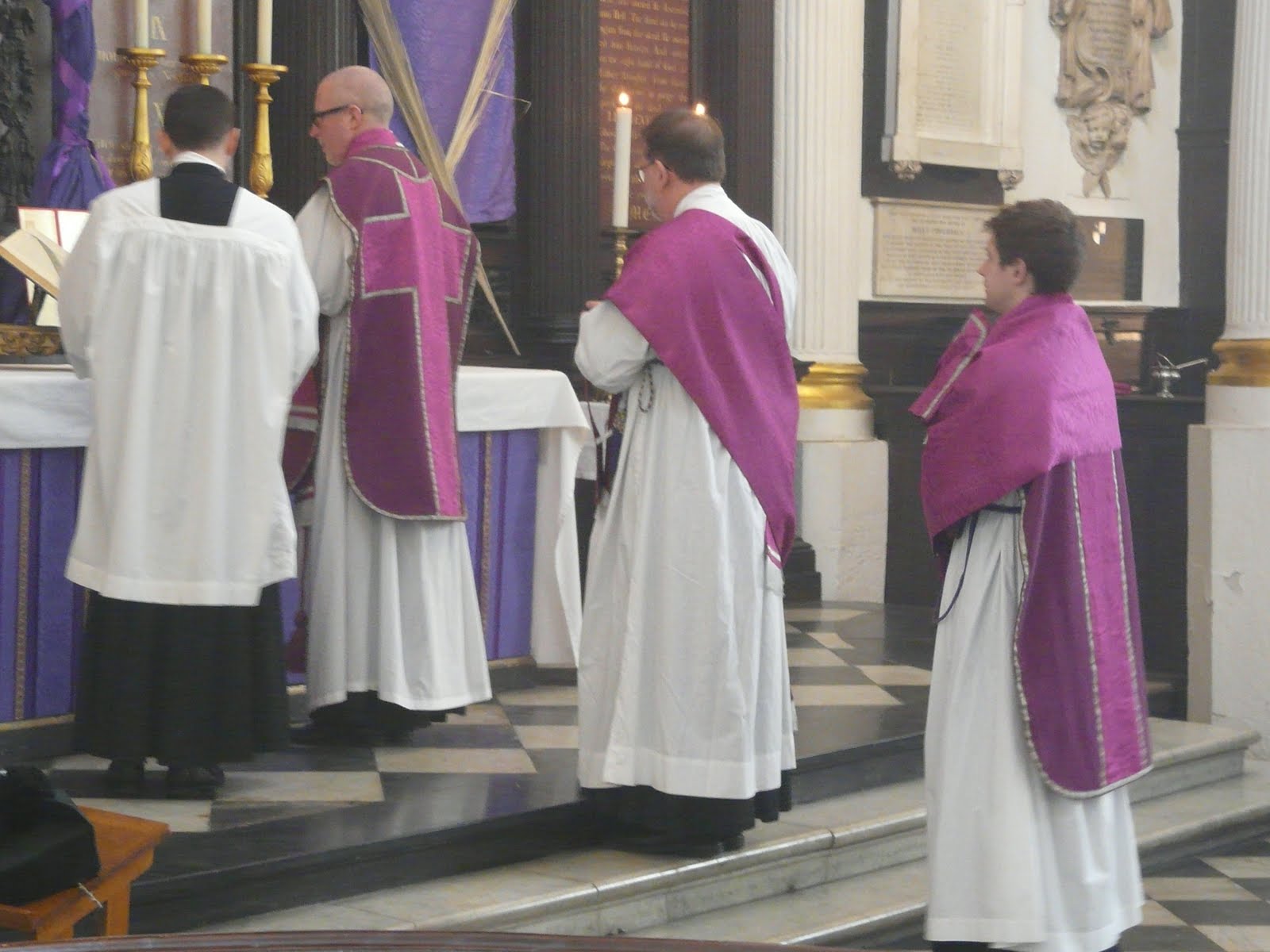
The blessing of the palms takes place within a ceremony that has the form of a little Mass, with its own Liturgy of the Word, Collects, Preface, Sanctus, and "Canon" of Blessing. This imitation-Mass clearly links the entrance to Jerusalem with the Passion that follows (in the Mass of the day). The vestments worn are folded chasubles for the Deacon and Subdeacon, and a cope for the Celebrant. The blessing and Mass both use purple, unlike the reformed rite instituted by Pius XII, and God only knows what happens in the Modern Roman Rite! In this picture the ministers arrive at the altar and move to the Epistle side.

Hosannah, Son of David is the Antiphon that corresponds to the Introit of a Mass, and at Oremus of the Collect, the Subdeacon goes to his place and removes his folded chasuble, before going to sing the Lesson from Exodus at the appointed place.

There is also a Gospel proper to the blessing, which recounts the entrance of Christ to the city. For this, the Deacon wears his broad stole as he would at Mass. The Celebrant is listening from the Epistle side, because the Missal has not been moved from the place of the Palms.


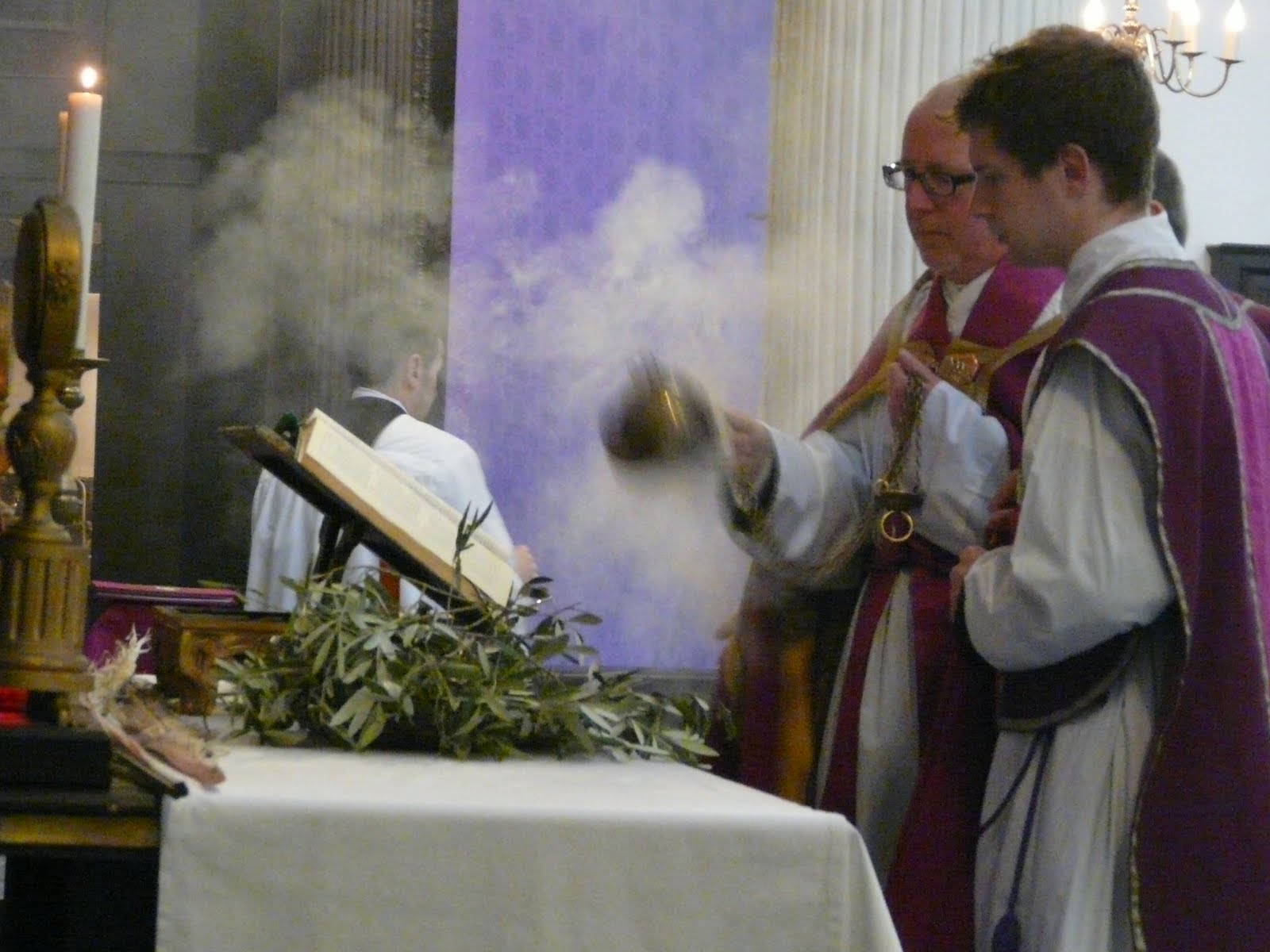
The Celebrant kisses the book and is censed as at Mass.

A preface follows, then a "canon" of five blessing prayers is said over branches of Olive and Palm.


The branches are lustrated and censed.

An assistant priest hands a palm to the Celebrant, and the ministers receive theirs kneeling.

Palms are then distributed to the faithful


The procession forms and leaves the church


The Subdeacon carries the veiled cross


When the procession arrives back at the church, two cantors remain inside and shut the doors. From inside they sing "all honour, laud and glory" which is repeated by those outside. After this dialogue, the Subdeacon strikes the door of the church thrice with the foot of the cross....


And the procession enters the church to the chanting of another Antiphon Ingredientem. As a side-bar, the piety of the women who chose to wear a Mantilla or a hat on this day is to be praised.


Mass proceeds as normal with the rules for Passiontide, except for the Chanting of the Passion, after which the end of the Passion is chanted as a normal Gospel, with incense (and acolytes but no lights) thereafter. Unfortunately I couldn't load the picture of the Celebrant, chanting the Passion as Christus at the Gospel side, while the narrator Chanted from the lectern.
This liturgy affected me in ways I didn't know it would. The sense of event which followed the first collect and reading, so familiar yet so different really caught my imagination. The silent, pregnant pause between the end of the Passion sung but the narrator, and the bit sung as the Gospel was truly dramatic and affecting. I have read that this climatic moment represents the desolation of the Church at the events described in the Passion. Even the slight pause that I made to genuflect while singing "and at the name of Christ...every knee shall bend" in the Epistle seemed appropriate, all leading up to the Great Event of the Eucharistic Sacrifice. I have rarely felt so free to engage with the Sacrifice as I did yesterday having heard the Passion sung. Hopefully I'll have time to post photos from the Triduum later this week. Stand by for a preview of our Good Friday vestments.


Monday, 18 January 2010

Cathedra Petri


Today is the feast of the Chair of S. Peter, and the beginning of the Week of Prayer for Christian Unity. This week of prayer, as many Anglicans will know, began life as the Octave for Christian Unity, proposed by Anglo-Catholic Fr. Paul Wattson in 1908 to be observed from the feast of the Chair of S. Peter on the 18th January until the feast of the Conversion of S. Paul on the 25th. The decision to observe the Octave over these two feasts is an obvious indication of the Anglican Papalists' desire for unity with the See of Peter, and as a glance over the history books and archives will tell, our Papalist forefathers took up this Octave of Prayer with great enthusiasm. As the idea caught on, the Octave came to be observed as the (perhaps less explicitly Catholic) Week of Prayer for Christian Unity, and was blessed by Pius X to be observed in the Roman Church. Since its promotion by the World Council of Churches, the Week (still actually an 'Octave') has been very widely accepted by Christians across the world.

This week I am also celebrating my new iPod Touch, a wonderful piece of technology which I almost can’t believe I ever lived without. Over the weekend I have been discovering the many wonderful applications I can download onto my new iPod: such practical things as a Spanish-English dictionary, an iSiddur (a Jewish prayerbook, just in case I ever find myself in shul on a Friday night), a Catholic Calender by Universalis with readings for Mass and the Liturgy of the Hours, a course of Salsa Lessons (to supplement my Wednesday night session) and plenty more besides. I’ve also subscribed to podcasts, which update automatically via iTunes, so that I can share in weekly Bible study sessions with a group of American Franciscan Sisters, as well as a daily documentary from the BBC!

Unfortunately, though, many of the things that I want aren’t available as applications or podcasts yet. While some churches do broadcast Mass daily online, there are no podcasts that I know of for the Usus Antiquior, and Sanctamissae.org is yet to release the Missale Romanum (1962) as an iPod application. Nonetheless, what I can get on my iPod and what I can watch on my PC involves such startling variety and seemingly endless possibilities for mission, that it isn’t surprising that so many in the Church are embracing the technology available, and podcasting sermons, broadcasting Masses or creating eRosary applications for iPhone.

At a parish meeting last year, the people of S. Magnus were encouraged to contribute their ideas in a brainstorming session as the first stage in formulating our MAP, or Mission Action Plan for the coming year. Reading over the notes of this meeting put together by one of our churchwardens, two very strong themes emerged from the participants' comments: firstly, a very strong and discerning appreciation of the traditional Liturgy offered in S. Magnus every Sunday, and secondly, the desire to see this precious gift shared with those who form the wider S. Magnus community, including tourists at the Monument, casual visitors, or, quite importantly, people who follow S. Magnus through this blog or the Church website, and who constitute the eParish of S. Magnus; our “virtual parishioners” as one person put it.

It seems that S. Magnus has accepted, in theory at least, the idea that one can be part of the community without being physically present (although obviously, it would be all the better if you could be!), and has begun to explore the possibilities of reaching out to our eParish via the internet and possibly Apple technology also. Some ideas that I’ve seen work well in other places are the simultaneous broadcast of the Sunday Mass (do look here at S. Gertrudes if you haven’t already enjoyed the broadcasts of these Traditionalist Roman Catholics in the States), and the podcasting of sermons to be downloaded to iTunes (S. Clement’s Philadelphia has done this for some time). The Parish website is also due to be revamped soon, and that could be very exciting, with an ordo and events calendar published and updated regularly, photo folders to look back over past events etc. All of this requires skill, effort and outlay, so your prayers are asked for our church of S. Magnus as it follows others into the mission fields of cyberspace! Who knows? It might not be too long before this blog is sharing video content from the Parish Mass or feast days, or whatever event we might be hosting, to give YOU, the virtual parishioners of S. Magnus, a regular dose of the M vitamin. And in this week of prayer for unity, while we are waiting for decisions to be made about Anglicanorum Coetibus, we must remember to ask the decision-makers the important questions: like, when will we get podcasts of Anglican Use High Mass?

Tuesday, 12 January 2010

Baptism of the Lord and Blessing of the Thames **UPDATED**

**UPDATE**
I have just received these pictures from our churchwarden, which were taken during the Mass of the Baptism of the Lord. They are a little fuzzy but considering we don't have a dedicated photographer, and the churchwarden naturally has his duties, readers will have to pardon us. The pictures offer a chance to see our newly acquired High Mass set doing what it was designed to do. It came from Elmore Abbey and as such exhibits the relatively simple decoration typical of monastic vestments, and it is cut in the Spanish style. You'll also notice the "true" dalmatic and tunicle, which are clearly differentiated from each other. The set includes a matching set of tabernacle veils and a humeral veil you could shelter an entire family under.
The offertory


Agnus Dei


Communion

Post-Communion


It is our custom at S. Magnus to process up to London Bridge after the Mass of this feast, to the point where our parish boundary meets that of the old S. Saviour's, Southwark (i.e. Southwark Cathedral) and there to conduct a ceremony of blessing the river, which involves readings, prayers for those who have lived and died on the river, before a large wooden cross is thrown into the Thames to bless it, and the people are sprinkled with holy water. This custom is followed by many of the faithful of the Eastern Churches, especially in Greece and Russia. My only experience to date of the Ethiopian feast of Timqat, which celebrates the Epiphany and Baptism in one go, was on my way back from Mass at Ss. Trinita dei Pellegrini in Rome, where I wandered into a small, typically Roman piazza and encountered a huge circle of Eritreans gathered around a collection of large plastic tubs full of water, where priests and deacons in colourful silk vestments were conducting their version of the blessing of the waters.


A short local media flurry (light relief from the "snow") followed the Blessing, with S. Magnus featured on BBC London television news, and also in the free commuter's daily, the Metro. It seems that every year, the event attracts more and more attention, and I'm pleased to think that so many people have been reminded of the contribution the Church makes to the City of London, not only by providing direct charitable and educational services, but also in that great service of intercessory prayer.


The procession forms, headed by an icon of the Baptism of Christ, held by Dr Colin Podmore


The procession on London Bridge


...waiting for Southwark


The Southwark contingent arrives


The service is underway


The cross is thrown into the Thames by Fr. Philip and Canon Andrew Nunn


Holy Water


The people are sprinkled as a reminder of their baptism


Tuesday, 17 November 2009

Traunstein


One quote from the brilliant book "Martin Travers: an appreciation" has always stuck in my mind, something about the interior of S. Magnus the Martyr looking, after it had been restored by Travers (and I'm paraphrasing) something like an Austrian country parish church that has been washed over by the counter-reformation. Well, in an idle moment today I got to looking at Austrian and Bavarian parish churches, and so compare the image of S. Magnus at the head of this page which the above image of the church in Traunstein, Bavaria, where a certain Fr. Ratzinger said his first Mass........

Friday, 3 July 2009

Jubilee Celebration


This photo is of the altar party of Fr Phlip Warner SSC's Mass celebrating 25 years of priestly ministry on Wednesday 1st July, Feast of the Precious Blood, at St. Magnus the Martyr.