Showing posts with label old rite. Show all posts

Tuesday, 7 June 2011

Pentecost Vigil II

Last Friday I had the most extraordinary encounter which I have been thinking of alongside this Saturday’s similarly extraordinary Pentecost Vigil. After an extremely onerous and dull day at work, I was dropped off near Mile End tube station by a colleague. I had intended to take the tube from there to my next engagement at Waterloo, but overcome by nostalgia for the foetid kebab joints and knife fights on the number 25 bus that comprise my memories of living in that part of London, I was persuaded instead to wander into Mile End park and take some sun. Unfortunately I fell asleep under the beating rays and woke up after half an hour looking like a spare rib, and I found myself rather in need of urgent refreshment. So, I retired to the nearest cafe, Roastars, under the “Green Bridge”, and sat down with several pint glasses of water and an iced latte. After a while, a young man with cropped hair and shorts asked if he could sit at my table, and naturally I replied “of course”. I noticed that he was wearing several bangles with cryptic slogans that I guessed must identify him as some sort of evangelical Christian. I suppose the mystery around such random inscriptions as WWJD or GODSTRONG are supposed to draw the curious into conversation with the wearer, and ultimately get them signed onto an Alpha course or something. This guy had two bracelets saying I AM SECOND, which definitely piqued my interest, and when I noticed he was writing out verses from Galatians in I AM SECOND-emblazoned notebooks, I said to myself “I have to find out who this nut is….and if I end up winding him up with my hardcore adherence to catholic doctrine then so be it”.

I shouldn’t have been so judgemental and self-assured. I so rarely encounter real live prots, and so my excitement at a perfect opportunity to counter-evangelise must be excused. Still, the ridiculous, arrogant idea that I was nurturing at that moment that I could convert him instantaneously with a salvo of rebuttals of his heretical non-doctrines and a visit to S. Magnus to seal the deal, should certainly not be excused. It turned out that I probably came away from that encounter having learnt far more profound things from him than I had managed to impart with my attempt to preach the True Faith.

We covered a range of topics; the Eucharist, the Blessed Virgin, invocation of the Saints, infant Baptism, and Confession and, of course, the Sacred Liturgy. Admittedly, although clearly a very devout young man, I have no problem saying that some of the views he expressed are heretical and run counter to the canons of the first ecumenical councils, which I had assumed would be our common ground. Then again, we are talking about a religion that teaches a form of sola scriptura that encourages a “what this Bible passages means to me personally in my life” individualist approach to Holy Writ, orchestrated by a succession of free-lance Pastors whose teaching authority derives more from their tithe-inflated bank balances than their endorsement by any legitimising or regulating system. This is a religion that has no concept of Tradition at all, in which “worship” consists of half an hour of preaching sandwiched between coffee and some soft Christian rock, and where the priestly exercise of Christ’s ministry of forgiveness in the Sacrament of Penance has been replaced by “discipleship meetings” with an “accountability partner”.

Our longest discussion was about infant baptism. I hope I managed to expound clearly the doctrine that the transformative grace imparted by the Sacrament of Baptism is not contingent upon the child’s understanding of what is happening. The Credobaptist Evangelical was not convinced and laid out the reasons – all worthy of consideration – why this is not so. We both claim that our respective beliefs are rooted in scripture, but mine are expressed in what I believe to be a Tradition shaped by the operation of the Holy Spirit, in which I can trust, and in which disagreements can be settled.

I won’t go further into Baptismal theology, as I am shamefully unschooled in anything beyond the very basics, but this discussion reminded me of the last time I witnessed the doctrinal vacuum created when Tradition retreats and subjectivity takes hold. I remember the first time our Parish celebrated Holy Week in the Older Rite, after the Paschal Vigil I received complaints from some parishioners who felt aggrieved at having been denied the opportunity to “renew their Baptismal promises” at the font, and that they were worried not having been able to do so. I sympathise with people who are attached to what, for them, is the only Paschal Vigil service they know, and I can completely understand how one would feel a sense of rupture, especially at so sensitive a time, in the pattern of worship they know, but I believe that these people, and countless other people who are subjected to the aliturgical modern rites year after year, have been persuaded to believe that the validity of their baptism is in peril, and they have been deceived by bad liturgy. Bad liturgy teaches bad theology, and for me, this is a perfect example.

The fact that the “baptismal promises”, the verbal assent to believe in Christ and rejection of Satan, were made on our behalf at our baptism as infants has no effect on our baptismal regeneration. At baptism, our soul is made entirely pure and white, this is what it means to die to sin and rise again to new life in the Sacramental waters of Baptism. While our souls may be sullied by sin as we grow older and attain reason and responsibility, our recourse is not to the “renewal” of those vows, but rather to the Sacraments of Penance and Holy Communion. The Sacrament of Confirmation is about “confirming”, at the age of reason, our initiation into the Church which is begun at Baptism. The supposed need to renew one’s baptismal promises annually at the Paschal Vigil erodes the teaching of the Church and brings nothing but confusion.

This morning I was looking over the texts of the Vigil of Pentecost, which as you can read below is a Baptismal Liturgy, which consists of the reading of Old Testament prophecies (the origin of which was to instruct the Catechumens), Blessing of the Font and Baptisms, Litany and then Mass in Red Vestments. As I read the collects, I realised how strongly this preparation for Pentecost, historically ranked second only to Easter, reverberates with the related themes of Baptismal regeneration and the operation of the Holy Spirit – our forefathers in the Faith had no need to worry about renewing their baptismal promises: the entire Liturgy sings with them. The many Collects between the prophecies ask for the continual outpouring of Grace on those already baptised.

O Lord God of hosts, who restorest those things that are broken down, and preservest those things that thou restorest : increase the peoples that shall be regenerated in the sanctification of thy name; that all who are washed in holy baptism may ever be guided by thy inspiration. Through.

Collect on the Sixth Prophecy

The character of this Liturgy was shaped by the first centuries of the Church, where entire households of Catechumens were received by Baptism: men, women AND their children. The Church was proclaiming in her Liturgy that there is one font of Baptism, one Fountain of this Grace from which these waters flow, and that all who wish to be saved must die to sin and be reborn: men, women, newborn children, regardless of physical or mental ability there is one font for all of them. This is a startling teaching, impossible to reconcile with worldly assumptions about people in different conditions of life, and it remains so today. There was no need for anxiety about one’s age or ability affecting their baptism because the Church proclaimed the opposite so confidently! So confidently, in fact, that it became impossible to baptise every Catechumen on the eve of Easter, and so the rest had to be baptised at the next Great Feast of Pentecost!

So what do we proclaim with the new non-Liturgies that have become the norm in the West? Ever noticed how those protestant pastors I mentioned above sometimes seem to be obsessed with one thing? The evil of homosexuality, the rapture, national apostasy, and the threat of Islam……These people re-mould Christianity around their own anxieties and obsessions and then impose this creed on their congregations, and they are not accountable. Whenever we liturgical practitioners presume to ad lib, excise, abolish, suppress, reform or tamper with the Liturgy, we behave exactly like those pastors, re-creating the worship of God in our own image to suit ourselves, not the diverse personalities of the plebs sancta Dei. Indeed what we are left with is no longer fit to be called leitourgia for that reason. We make it up as we go along...we make it "high looking" to impress people, or we make it cuddly to indulge certain expectations, allowing the zeitgeist to inform the Sacred Liturgy, and the Church, instead of the other way around. We find ourselves standing before nothing more than a wooden coffee table, and a font that is only a few drops deep. We end up seeking God’s forgiveness from our “accountability partner” and sipping coffee between hollow smiles, telling ourselves how good it all makes us feel to be a Christian.

Saturday, 4 June 2011

The Vigil of Pentecost

The Vigil of Pentecost will be celebrated in the Church of S. Magnus on Saturday 11th June at 6.30pm. This vigil, supressed in the devastating 1955 Holy Week reforms, is now almost never celebrated, and I am informed that if we manage to find Deacon and Subdeacon for our celebration at S. Magnus, it will likely be the first such celebration in this country since the vigil was supressed.

Gregory DiPippo's excellent Compendium of the Holy Week reforms, published on the New Liturgical Movement blog, includes a description of this Vigil, to which I can add little.

Synopsis of the Pre-Pius XII Ritual

Already in very ancient times, the sacrament of baptism was celebrated on the feast of Pentecost as on Easter; this is said explicitly by Pope Saint Siricius (384-399) in a letter to bishop Himerius of Tarragon. (Epist. ad Himerium cap. 2 : Patrologia Latina vol. XIII, col. 1131B-1148A) Pope Saint Leo I (440-461) reasserts that this was the practice of the Church in a letter to the bishops of Sicily, exhorting them to follow the example of the Apostle Peter, who baptized three thousand persons on Pentecost day. (Epist. XVI ad universos episcopos per Siciliam constitutos : P.L. LIV col. 695B-704A) This custom is expressed in the liturgy of the vigil of Pentecost, which resembles in many respects the rite of Holy Saturday. This resemblance is found in the Missal of St. Pius V, as in all of the missals that came before it, and in the medieval usages of the great cathedrals and religious orders.
The rite begins in the penitential color, violet. There is no blessing of a Paschal fire, nor of a Paschal candle, nor the Exsultet; therefore, the vigil begins with six prophecies, repeated from the vigil of Easter, each of which is followed by a prayer. (The three tracts from Easter night are also repeated in their respective places). The six prayers are different from those of the Easter vigil, but express in many respects the same ideas. After the sixth prophecy, the blessing of the baptismal font is repeated, changing only the prayer at the beginning, following which the Litany is sung. During the Litany, the major ministers return to the sacristy and change to red vestments for the Mass.

Other rites of the Easter vigil are repeated at this vigil Mass; there is no Introit, and the bells are rung at the Gloria in excelsis. (The Introit Cum sanctificatus fuero was later assigned for private Masses only.) The collect of the Mass refers to the baptismal character of this celebration even more clearly than that of the Easter vigil Mass. After the Alleluja of the Mass is sung the same Tract which is sung on Easter night. At the Gospel, the acolytes do not carry candles. Just as on Easter night the Resurrection is watched for, but not anticipated, so also with this same gesture, the Church watches for the coming of the Holy Spirit in tongues of fire, as Christ told His disciples to do, but does not anticipate it. A further reference to the baptisms done in the first part of the rite is found in the Canon of the Mass, in which the proper Hanc igitur of Easter is said. This text speaks explicitly of those whom the Lord “(has) deigned to regenerate of water and the Holy Spirit, granting to them remission of their sins. ” It is said in this Mass, and though the entire octave of Pentecost, as it is also said at the Mass of the Easter vigil, and throughout the octave.


Synopsis of the Pius XII Reforms

The 1955 reform almost completely removes this ancient tradition of the Roman Rite, suppressing the Prophecies, the blessing of the font, and the Litany. The Mass begins with the Introit which was formerly said only in private Masses. The rubrics about ringing the bells during the Gloria and not carrying candles at the Gospel are also suppressed. The text of the Mass itself is not changed; the same collect and the same Easter Hanc igitur are still said, although the baptismal rituals to which they refer are suppressed.
Copyright Gregory DiPippo 2009

So I'd urge you come to S. Magnus to take part in this most ancient and excellent preparation for the Great Feast of Pentecost. I don't know that another Church in London will be celebrating the vigil and although we hope to repeat it next year, God willing, this could be your one chance to attend this service. See you there!

Tuesday, 28 December 2010

Childermas


Today's feast of the Holy Innocents is known in English as Childermas. This feast is a real liturgical curiosity. Certainly very ancient (going back in the West to at least 485), this feast is pegged in different traditions to either the "Sanctoral" or the "Seasonal" cycle of the year. While the Latin church keeps this feast on the 28th December, the Greeks on the 29th and the Syrians and Assyrians on the 27th, the Armenians on the Monday after the second Sunday of Pentecost, as they maintain that the Holy Innocents were killed fifteen weeks after the Nativity.

Another curiosity is the liturgical colour used for the feast. If the feast falls on a weekday, Violet is used. This stems from the Roman argument that since the Innocents were killed before they were able to attain the beatific vision, they should not be commemorated as other Martyrs, but in honour of the women of Bethlehem, the Gloria and Alleluia are not sung at the Mass. In the Gallican rites of France and parts of Germany, this distinction was not made and Red was used along with the Gloria and Alleluia. Therefore, in the Old Roman Rite, Violet is used if the feast falls on a weekday and Red is used if it falls on a Sunday (and on the Octave day, when the Gloria and Alleluia are also sung), a rare example of compromise between Roman and local uses.

In England, there was a custom of not working on whatever day of the week the feast fell on for the rest of the year until the next Childermas. It would be logical to assume that this custom was only followed by the very wealthy.

Wednesday, 3 November 2010

Priests, Deacons, Subdeacons...and Ethiopians

(Picture from Wikipedia)

I don't have much time to linger on Liturgical blogs these days, alas. Whenever I do look at RC tradworld blogs, however, I do notice one feature of tradworld liturgies that irks me: the practice of priests serving the Liturgy not as priests, but rather as Deacons and Subdeacons. I've also been reading a little about the Ethiopian rite of the Divine Liturgy and tradworld vs Ethiopian Orthodox is quite a contrast.

Reading tradworld rubrical guides, new and reprinted, one often sees instructions to the effect that Priests may carry out the functions of the Deacon or Subdeacon at Mass, or similar. In the Latin rite, a layman may fulfill the functions of the Subdeacon, with certain restrictions, of course, on what he can wear and do. This raises several important questions about how the Western Church "does" Liturgy: Are we saying that the rite is inherently defective, because it puts into vestments a person (the Subdeacon) who needn't be ordained to fulfill that office? Why is it that under current rules, both an ordained priest and a layman can serve as Subdeacons at the Liturgy? Does that make sense? Is there supposed to be a sharp line between clergy and laity, and which side of the Minor Orders does it fall on?

At the Ethiopian Liturgy, one will find at least five (seven is canonically correct) ministers: The Celebrant, the Assistant Priest, the Deacon, the Subdeacon, and the Lector, to which Fanbearer and Acolyte are added to make up the canonically required seven. A Priest assists, but he does so as an Assistant Priest. There is no notion of "demoting" him to the rank of Deacon for the duration of the liturgy.

Western practice begs the question, what actually is the Priest-Deacon? Is he a just a Priest in Deacon's clothing? If he is, why does he receive Communion with his stole tied inappropriately, or if he's acting as Subdeacon, not at all? The inconsistencies that arise, where the Priest in choir is expected to receive Communion in a stole, but the Priest-in-Tunicle isn't!

Another major question is that of the relationship between Office and Liturgical Function. My understanding of Orders, starting from scripture and going on to the Fathers, is that each clerical order has both an Office and a Function. In some cases, the liturgical function overlaps a little: Bishops and Priests both celebrate the Liturgy, Subdeacons and Lectors (formerly) both chant Readings. Yet, their respective offices are not precisely the same. Is it right then, for a priest to temporarily relinquish his proper function to fulfill that of another minister, or for a layman to usurp the liturgical function proper to a Subdeacon?

This might all seem like so much splitting of hairs, and shying away from providing real answers. But comparing the Ethiopian and Latin-rite practice reveals the massive gulf between how East and West project their own notions of convenience onto the Liturgy.

Convenience does matter, though. In my church, I'm used to priests acting as Deacons. We don't have a Deacon affiliated to the Parish, and when one visits, he acts as Deacon. Luckily though, I don't think I've ever seen a Priest act as Subdeacon in the Parish (which must be one of the worst liturgical solecisms ever!). The rotation of lay servers in this role is perhaps not the ideal, but is certainly better practice than using a priest, and approaches at least a "simulation" of ministers in minor orders. And to my mind, the minor orders are the answer to this problem. That and the promotion of the Diaconate. One of the good things (but possibly the worst named) to come out of late twentieth-century mucking around with the Liturgy is the revival of the "Permanent" Diaconate, individuals who are ordained as Deacons to fulfill the Office of pastoral care and teaching, and the Functions of the Deacon at the Liturgy. Surely that is the first step in achieving an understanding of orders that chimes with scripture and tradition.

Monday, 5 July 2010

Procession of the Relic of S. Thomas of Canterbury


This Sunday at S. Magnus we kept the Feast of the Translation of the Relics of S. Thomas of Canterbury. After a Sung Mass, a relic of the Saint which was kindly lent to us for the occassion was transferred from the High Altar to a Feretory and Bier, and taken in Procession, carried by two Subdeacons, to London Bridge. The Old London Bridge, whose thoroughfare formerly went under the bell tower of S. Magnus, once had a chapel dedicated to Saint Thomas of Canterbury where pilgrims on the medieval pilgrimage route would gather before heading over to Southwark and on to Canterbury. This chapel, which is depicted in a window and model in S. Magnus church belonged to the Parish of Saint Magnus the Martyr, and so we have inherited that saint's special patronage.


The Mass was Sung by the Vicar, Fr Philip, who wore a red chasuble featuring the Arms of Saint Thomas.


As the Procession left the church, the choir began singing the petitions of the Litany of the Saints.


Here you can see the beginning of the Procession. You'll notice that S. Magnus maintains the venerable tradition of the Verger, who carries a mace and wears a distinctive verger's hat.


The Procession goes up the steps from Lower Thames Street onto the Bridge.


At the approximate place of the former Chapel, the relics made a station, and the Office of Sext was sung. This was followed by the Anthem of the Benedictus of the Office of S. Thomas of Canterbury, using the Sarum chant. On the return to the Church, the "praise psalms" 148, 149 and 150 were sung. On arriving at the church, the choir sang the Antiphon of the Magnificat of the aforementioned Office, followed by the versicle and collect. The reliquery was then removed from the Feretory, and place on the High Atlar, then censed, and the faithful had an opportunity to venerate. The reliquery also contained a fragment of the True Cross, among other relics, which explains the genuflections made by some. After Benediction of the Relic, the dismissal was given and all retired to a delicious curry lunch in the sun.

Saturday, 3 April 2010

Good Friday in the Older Rite at S. Magnus


The ministers enter the Sanctuary, genuflect and prostrate. Two Acolytes spread an altar cloth on the bare altar and place the missal at the Epistle corner. In the photo above, the Celebrant looks over the reading that is being read by a lector.

After a collect, the Subdeacon chants a reading from Exodus as an Epistle.

The Celebrant sings Christus during the Passion


After the Passion and Gospel, the ministers go to the Altar for the Litanical, or bidding prayers. The intention is introduced by the Celebrant, and the Deacon sings "Let us bend the knee".


After a time kneeling, the Subdeacon sings "Arise" and the Celebrant sings the Collect.


During the Collect for the Conversion of the Jews, an acolyte spreads the carpet and cushion in preparation for the Worship of the Cross.


The Deacon goes to collect the veiled cross from the Altar and brings it to the Celebrant at the Epistle corner.


The Celebrant reveals the right arm of the crufied, and sings "Behold the wood of the cross, whereon the world's salvation was hung", all reply "O come let us worship" and kneel in adoration.

The Celebrant climbs a step, and repeats the above revealing the title board. Finally, he removes the veil entirely before the High Altar. He then places the Cross on a purple cushion (to symbolise Christ's regality) topped with a white veil (to represent His innocence, and His burial shroud) to venerate It.


After this, the Subdeacon and Deacon venerate the cross.


The other ministers come thereafter to venerate, making three double genuflections with prostration as they go. This is what our ancestors in England called "creeping to the Cross".


A relic of the True Cross is prepared also for public veneration.


The relic is venerated by the faithful.

The choir sing the reproaches, recited quietly at the bench.


The Deacon places the Cross on the High Altar


A procession is made to the Altar of Repose, and the Celebrant assumes a white humeral veil.


The procession of the Sacrament back from the altar is the first part of the Mass of the Pre-sanctified.


Here, the celebrant is seen censing the Elements. He has prepared a chalice of unconsecrated wine which also stands on the corporal. The Eucharist is censed, as is the altar but the Celebrant is not. He then says the Pray Brethren, not turning all the way, sings the Libera nos, performs the fraction and with some Communion devotions, receives the Host consecrated at Yesterday's Mass.


In deference to Local Custom, the faithful also receive Communion from a number of Hosts reserved with the Priest's Host.


There being no other ceremonies, the ministers stand to sing "When I survey the wondrous Cross" before retiring to the Sacristy.

The ministers in the Sanctuary after the Liturgy

Monday, 29 March 2010

Palm Sunday in the pre-Pian rite


With no disrepect intended to the Venerable Pius XII, the Holy Week reforms that became effective during his pontificate truly make a dog's breakfast of the most important week in the liturgical year. I didn't quite realise how true that was until yesterday, when I assisted at a pre-Pian Palm Sunday for the first time, and realised why so many choose to cleave to this excellent tradition of liturgy. Not everyone will be familiar with the old-Old Rite rites, so I will try to describe the photos I have shared.

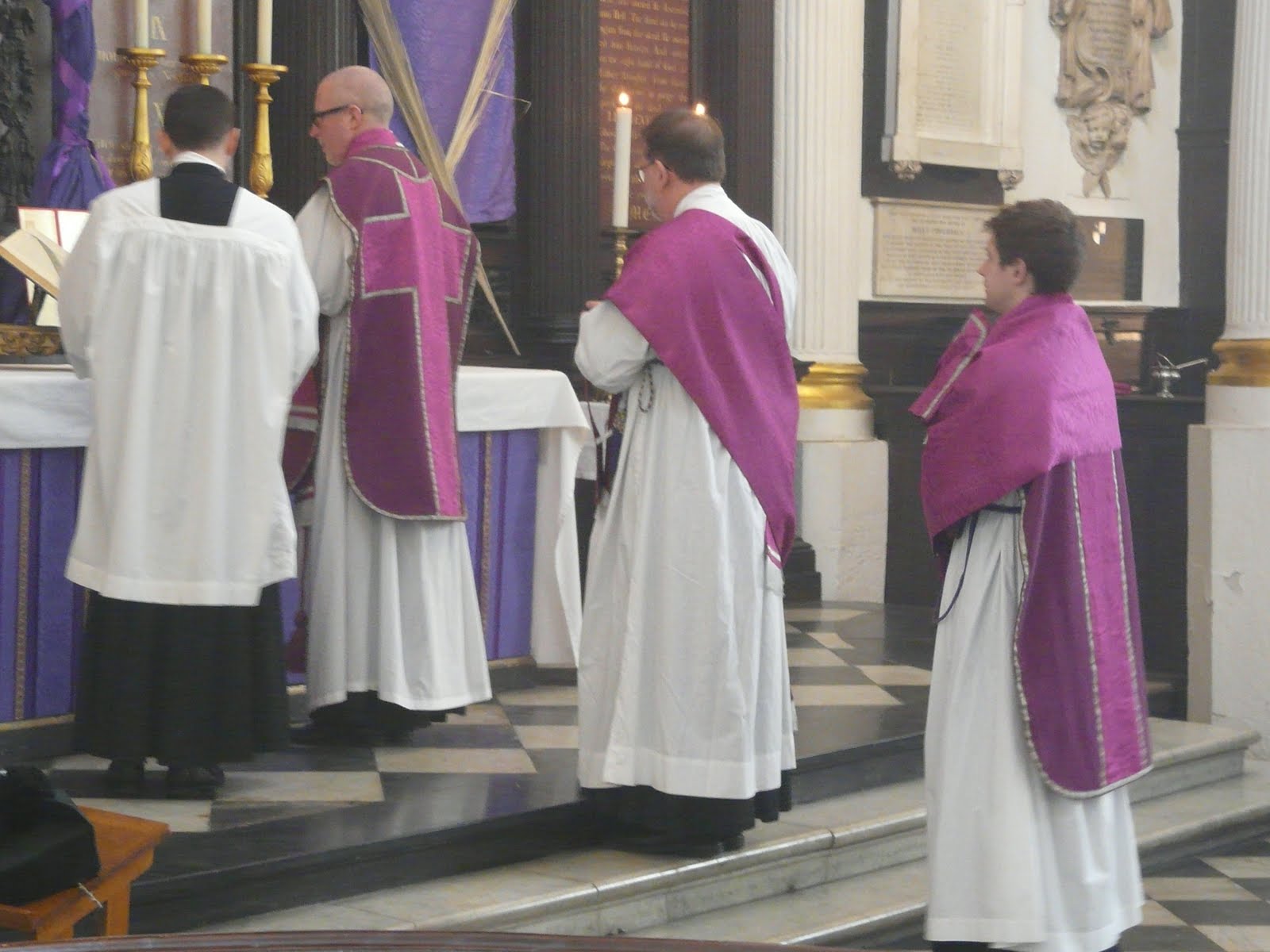
The blessing of the palms takes place within a ceremony that has the form of a little Mass, with its own Liturgy of the Word, Collects, Preface, Sanctus, and "Canon" of Blessing. This imitation-Mass clearly links the entrance to Jerusalem with the Passion that follows (in the Mass of the day). The vestments worn are folded chasubles for the Deacon and Subdeacon, and a cope for the Celebrant. The blessing and Mass both use purple, unlike the reformed rite instituted by Pius XII, and God only knows what happens in the Modern Roman Rite! In this picture the ministers arrive at the altar and move to the Epistle side.

Hosannah, Son of David is the Antiphon that corresponds to the Introit of a Mass, and at Oremus of the Collect, the Subdeacon goes to his place and removes his folded chasuble, before going to sing the Lesson from Exodus at the appointed place.

There is also a Gospel proper to the blessing, which recounts the entrance of Christ to the city. For this, the Deacon wears his broad stole as he would at Mass. The Celebrant is listening from the Epistle side, because the Missal has not been moved from the place of the Palms.


The Celebrant kisses the book and is censed as at Mass.

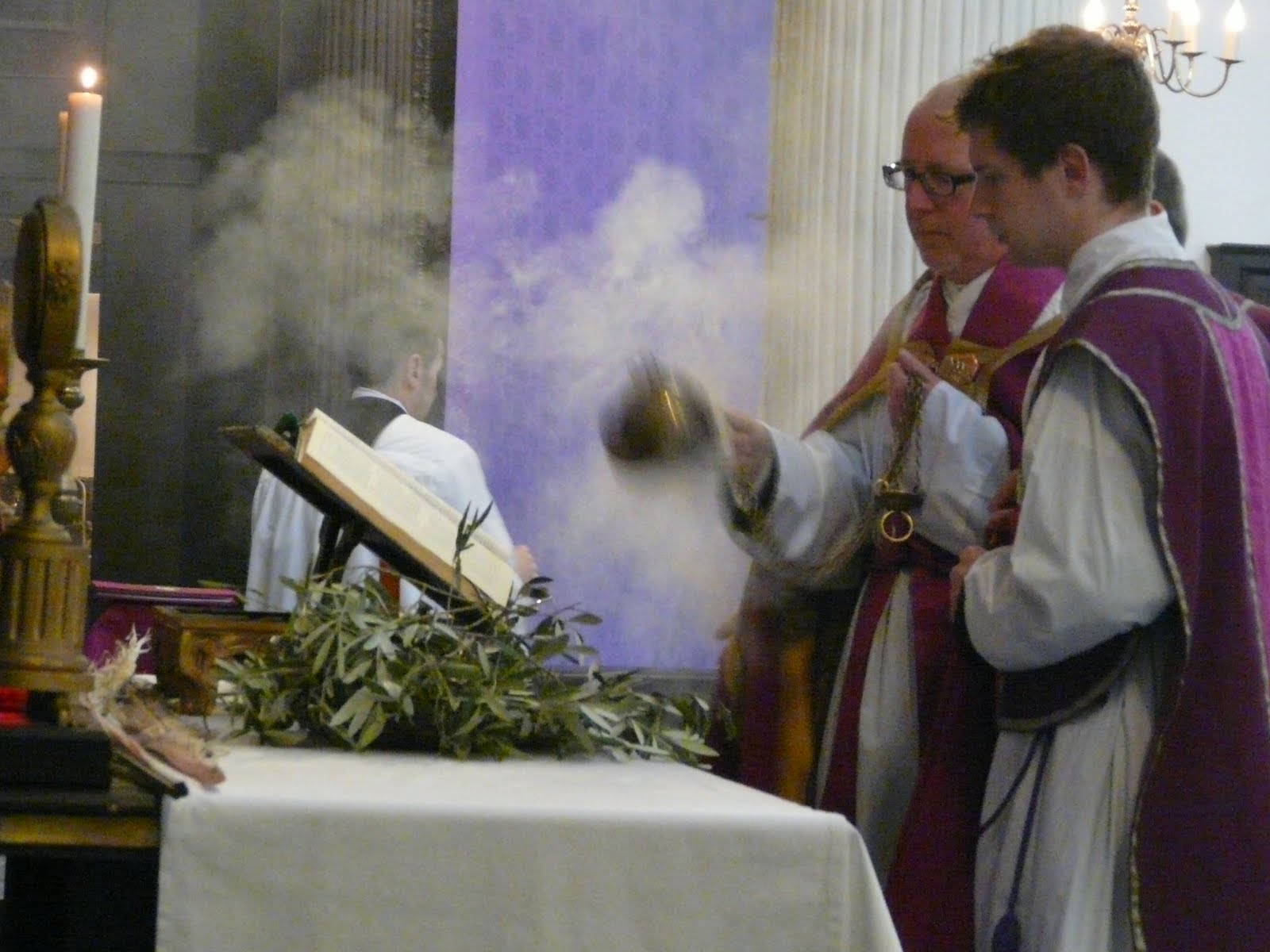
A preface follows, then a "canon" of five blessing prayers is said over branches of Olive and Palm.


The branches are lustrated and censed.

An assistant priest hands a palm to the Celebrant, and the ministers receive theirs kneeling.

Palms are then distributed to the faithful


The procession forms and leaves the church


The Subdeacon carries the veiled cross


When the procession arrives back at the church, two cantors remain inside and shut the doors. From inside they sing "all honour, laud and glory" which is repeated by those outside. After this dialogue, the Subdeacon strikes the door of the church thrice with the foot of the cross....


And the procession enters the church to the chanting of another Antiphon Ingredientem. As a side-bar, the piety of the women who chose to wear a Mantilla or a hat on this day is to be praised.


Mass proceeds as normal with the rules for Passiontide, except for the Chanting of the Passion, after which the end of the Passion is chanted as a normal Gospel, with incense (and acolytes but no lights) thereafter. Unfortunately I couldn't load the picture of the Celebrant, chanting the Passion as Christus at the Gospel side, while the narrator Chanted from the lectern.
This liturgy affected me in ways I didn't know it would. The sense of event which followed the first collect and reading, so familiar yet so different really caught my imagination. The silent, pregnant pause between the end of the Passion sung but the narrator, and the bit sung as the Gospel was truly dramatic and affecting. I have read that this climatic moment represents the desolation of the Church at the events described in the Passion. Even the slight pause that I made to genuflect while singing "and at the name of Christ...every knee shall bend" in the Epistle seemed appropriate, all leading up to the Great Event of the Eucharistic Sacrifice. I have rarely felt so free to engage with the Sacrifice as I did yesterday having heard the Passion sung. Hopefully I'll have time to post photos from the Triduum later this week. Stand by for a preview of our Good Friday vestments.


Friday, 22 May 2009

The Old Rite


I hope that a good Ascension Day was had by all. Whenever I hear the word ascension, the first image that pops into my mind is the Ascension chapel in the Shrine Church at Walsingham, of that little moulding on the ceiling of two feet taken up into cloud. The reredos of that chapel is gilded wood and the impression is one of movement upwards, guiding the heart to what is above, beyond the low ceiling of the chapel to the heavens above, where Christ reigns in glory.

I love the Ascension, because it’s imagery and readings are so physical, so personal. Just like Christ showing his wounds to the disciples, and inviting them to touch them, the Ascension was a tangible, real event, with the resurrected body of Christ on full view. Like Easter, the Ascension is also the fulfilment of a promise, and invites us to trust in Christ, and to be a friend to Him.

At S. Magnus, we kept the Feast with an evening Low Mass from the English Missal. Although every Sunday we use the Anglican Missal for Solemn Mass, we do not employ all of the ceremonial of the ‘Western Use’. However, during Lent, we started offering Low Mass from the English Missal and celebrated precisely according to the rubrics of the rite. This has meant many hours poring over Fortescue’s Ceremonies of the Roman Rite Described, specifically the 1958 edition which corresponds to our edition of the English Missal. I’ve also spent hours on youtube and google video watching recordings of Masses celebrated according to the 1962 Missale Romanum. As a server, I’ve also availed myself of countless small booklets and guides to serving the Tridentine Mass, and I often wonder why the information doesn’t stick in my mind, especially since most of those guides were written for children of about twelve years old.

So far, this has been a success. Although I do panic slightly before Mass that I might forget where I am supposed to be at a certain point, or that I might mess up the ablutions or miss a response, but yesterday’s Mass was very moving, especially as we were lucky enough to have a member of the choir chant the Introit, Kyrie, Gloria, Gradual, Offertory and Agnus Dei unaccompanied. It is very humbling to know that the prayers of the canon are the same prayers, unaltered over the ages, as were uttered by S. Augustine when he said his first Mass in England, and humbling too to know that this rite is the one with which so many of the saints would be familiar. It is truly the Mass of Ages, the unique heritage of the Church.

We all know that the Tridentine Rite of the Roman Catholic Church is increasingly in demand these days, but in our own Communion, the interest in ‘traditional liturgy’ has been somewhat more vaguely attached to the general visual aspect of the Liturgy, the indices of Anglo-Catholicism for the uninitiated: Birettas, incense and that sort of thing. Still, it seems there are plenty of people who are interested in doing things properly, and appreciate the timeless and transcendental quality of the Old Rite, offered with the complete and correct ceremonial directed in the rubrics.

It has long seemed to me, especially since a post on Anglican Wanderings about the use of the American Missal in Nashotah, that we would benefit greatly from an Old Rite Society, parallel to something like the Latin Mass Society, to promote the use of the various Anglican Missals (without preferring any particular one) and to provide listings of Old Rite Masses offered regularly or on Solemnities. You’ll notice I’ve been using the term Old Rite quite vaguely, and it’s basically a catch-all term I’ve settled on. I think the term Usus Antiquior belongs specifically to the Roman Missal and Extraordinary Form belongs to the Roman Communion. Our Missals are a much more diverse grouping of books incorporating various amounts of the Book of Common Prayer, which as we know, exists in various manifestations in different parts of the world. Still, what I believe constitutes an Old Rite Missal, is anything based on or translated from the Roman Missal in its various editions between 1570 and 1962 and incorporating any amount of Sarum or BCP material. I suppose that would include, apart from the Missale Romanum, which I know some people use, the English Missal, the Anglican Missal (published by the SSPP) and the American Missal among others.

To that end then, I would like any priests who offer public masses according to any Old Rite, or people who know of such celebrations, to email me Mass times to be published every Thursday or Friday (for the weekend) and at least two days before any Feast or Solemnity. I know of some parishes in the US who regularly use the English Missal, and I know of one in the UK, but please help by letting me know who I can contact for confirmation before advertising the Masses.
Either post the regular Mass times in the comments box of this post, or email me if you know of a particular celebration coming up. There are many people who would love to attend an Old Rite Mass, but who simply don’t know which parishes offer them, so with your help they’ll be able to attend the Traditional Liturgy as they wish.