Showing posts with label holy week. Show all posts

Tuesday, 7 June 2011

Pentecost Vigil II

Last Friday I had the most extraordinary encounter which I have been thinking of alongside this Saturday’s similarly extraordinary Pentecost Vigil. After an extremely onerous and dull day at work, I was dropped off near Mile End tube station by a colleague. I had intended to take the tube from there to my next engagement at Waterloo, but overcome by nostalgia for the foetid kebab joints and knife fights on the number 25 bus that comprise my memories of living in that part of London, I was persuaded instead to wander into Mile End park and take some sun. Unfortunately I fell asleep under the beating rays and woke up after half an hour looking like a spare rib, and I found myself rather in need of urgent refreshment. So, I retired to the nearest cafe, Roastars, under the “Green Bridge”, and sat down with several pint glasses of water and an iced latte. After a while, a young man with cropped hair and shorts asked if he could sit at my table, and naturally I replied “of course”. I noticed that he was wearing several bangles with cryptic slogans that I guessed must identify him as some sort of evangelical Christian. I suppose the mystery around such random inscriptions as WWJD or GODSTRONG are supposed to draw the curious into conversation with the wearer, and ultimately get them signed onto an Alpha course or something. This guy had two bracelets saying I AM SECOND, which definitely piqued my interest, and when I noticed he was writing out verses from Galatians in I AM SECOND-emblazoned notebooks, I said to myself “I have to find out who this nut is….and if I end up winding him up with my hardcore adherence to catholic doctrine then so be it”.

I shouldn’t have been so judgemental and self-assured. I so rarely encounter real live prots, and so my excitement at a perfect opportunity to counter-evangelise must be excused. Still, the ridiculous, arrogant idea that I was nurturing at that moment that I could convert him instantaneously with a salvo of rebuttals of his heretical non-doctrines and a visit to S. Magnus to seal the deal, should certainly not be excused. It turned out that I probably came away from that encounter having learnt far more profound things from him than I had managed to impart with my attempt to preach the True Faith.

We covered a range of topics; the Eucharist, the Blessed Virgin, invocation of the Saints, infant Baptism, and Confession and, of course, the Sacred Liturgy. Admittedly, although clearly a very devout young man, I have no problem saying that some of the views he expressed are heretical and run counter to the canons of the first ecumenical councils, which I had assumed would be our common ground. Then again, we are talking about a religion that teaches a form of sola scriptura that encourages a “what this Bible passages means to me personally in my life” individualist approach to Holy Writ, orchestrated by a succession of free-lance Pastors whose teaching authority derives more from their tithe-inflated bank balances than their endorsement by any legitimising or regulating system. This is a religion that has no concept of Tradition at all, in which “worship” consists of half an hour of preaching sandwiched between coffee and some soft Christian rock, and where the priestly exercise of Christ’s ministry of forgiveness in the Sacrament of Penance has been replaced by “discipleship meetings” with an “accountability partner”.

Our longest discussion was about infant baptism. I hope I managed to expound clearly the doctrine that the transformative grace imparted by the Sacrament of Baptism is not contingent upon the child’s understanding of what is happening. The Credobaptist Evangelical was not convinced and laid out the reasons – all worthy of consideration – why this is not so. We both claim that our respective beliefs are rooted in scripture, but mine are expressed in what I believe to be a Tradition shaped by the operation of the Holy Spirit, in which I can trust, and in which disagreements can be settled.

I won’t go further into Baptismal theology, as I am shamefully unschooled in anything beyond the very basics, but this discussion reminded me of the last time I witnessed the doctrinal vacuum created when Tradition retreats and subjectivity takes hold. I remember the first time our Parish celebrated Holy Week in the Older Rite, after the Paschal Vigil I received complaints from some parishioners who felt aggrieved at having been denied the opportunity to “renew their Baptismal promises” at the font, and that they were worried not having been able to do so. I sympathise with people who are attached to what, for them, is the only Paschal Vigil service they know, and I can completely understand how one would feel a sense of rupture, especially at so sensitive a time, in the pattern of worship they know, but I believe that these people, and countless other people who are subjected to the aliturgical modern rites year after year, have been persuaded to believe that the validity of their baptism is in peril, and they have been deceived by bad liturgy. Bad liturgy teaches bad theology, and for me, this is a perfect example.

The fact that the “baptismal promises”, the verbal assent to believe in Christ and rejection of Satan, were made on our behalf at our baptism as infants has no effect on our baptismal regeneration. At baptism, our soul is made entirely pure and white, this is what it means to die to sin and rise again to new life in the Sacramental waters of Baptism. While our souls may be sullied by sin as we grow older and attain reason and responsibility, our recourse is not to the “renewal” of those vows, but rather to the Sacraments of Penance and Holy Communion. The Sacrament of Confirmation is about “confirming”, at the age of reason, our initiation into the Church which is begun at Baptism. The supposed need to renew one’s baptismal promises annually at the Paschal Vigil erodes the teaching of the Church and brings nothing but confusion.

This morning I was looking over the texts of the Vigil of Pentecost, which as you can read below is a Baptismal Liturgy, which consists of the reading of Old Testament prophecies (the origin of which was to instruct the Catechumens), Blessing of the Font and Baptisms, Litany and then Mass in Red Vestments. As I read the collects, I realised how strongly this preparation for Pentecost, historically ranked second only to Easter, reverberates with the related themes of Baptismal regeneration and the operation of the Holy Spirit – our forefathers in the Faith had no need to worry about renewing their baptismal promises: the entire Liturgy sings with them. The many Collects between the prophecies ask for the continual outpouring of Grace on those already baptised.

O Lord God of hosts, who restorest those things that are broken down, and preservest those things that thou restorest : increase the peoples that shall be regenerated in the sanctification of thy name; that all who are washed in holy baptism may ever be guided by thy inspiration. Through.

Collect on the Sixth Prophecy

The character of this Liturgy was shaped by the first centuries of the Church, where entire households of Catechumens were received by Baptism: men, women AND their children. The Church was proclaiming in her Liturgy that there is one font of Baptism, one Fountain of this Grace from which these waters flow, and that all who wish to be saved must die to sin and be reborn: men, women, newborn children, regardless of physical or mental ability there is one font for all of them. This is a startling teaching, impossible to reconcile with worldly assumptions about people in different conditions of life, and it remains so today. There was no need for anxiety about one’s age or ability affecting their baptism because the Church proclaimed the opposite so confidently! So confidently, in fact, that it became impossible to baptise every Catechumen on the eve of Easter, and so the rest had to be baptised at the next Great Feast of Pentecost!

So what do we proclaim with the new non-Liturgies that have become the norm in the West? Ever noticed how those protestant pastors I mentioned above sometimes seem to be obsessed with one thing? The evil of homosexuality, the rapture, national apostasy, and the threat of Islam……These people re-mould Christianity around their own anxieties and obsessions and then impose this creed on their congregations, and they are not accountable. Whenever we liturgical practitioners presume to ad lib, excise, abolish, suppress, reform or tamper with the Liturgy, we behave exactly like those pastors, re-creating the worship of God in our own image to suit ourselves, not the diverse personalities of the plebs sancta Dei. Indeed what we are left with is no longer fit to be called leitourgia for that reason. We make it up as we go along...we make it "high looking" to impress people, or we make it cuddly to indulge certain expectations, allowing the zeitgeist to inform the Sacred Liturgy, and the Church, instead of the other way around. We find ourselves standing before nothing more than a wooden coffee table, and a font that is only a few drops deep. We end up seeking God’s forgiveness from our “accountability partner” and sipping coffee between hollow smiles, telling ourselves how good it all makes us feel to be a Christian.

Saturday, 3 April 2010

Good Friday in the Older Rite at S. Magnus


The ministers enter the Sanctuary, genuflect and prostrate. Two Acolytes spread an altar cloth on the bare altar and place the missal at the Epistle corner. In the photo above, the Celebrant looks over the reading that is being read by a lector.

After a collect, the Subdeacon chants a reading from Exodus as an Epistle.

The Celebrant sings Christus during the Passion


After the Passion and Gospel, the ministers go to the Altar for the Litanical, or bidding prayers. The intention is introduced by the Celebrant, and the Deacon sings "Let us bend the knee".


After a time kneeling, the Subdeacon sings "Arise" and the Celebrant sings the Collect.


During the Collect for the Conversion of the Jews, an acolyte spreads the carpet and cushion in preparation for the Worship of the Cross.


The Deacon goes to collect the veiled cross from the Altar and brings it to the Celebrant at the Epistle corner.


The Celebrant reveals the right arm of the crufied, and sings "Behold the wood of the cross, whereon the world's salvation was hung", all reply "O come let us worship" and kneel in adoration.

The Celebrant climbs a step, and repeats the above revealing the title board. Finally, he removes the veil entirely before the High Altar. He then places the Cross on a purple cushion (to symbolise Christ's regality) topped with a white veil (to represent His innocence, and His burial shroud) to venerate It.


After this, the Subdeacon and Deacon venerate the cross.


The other ministers come thereafter to venerate, making three double genuflections with prostration as they go. This is what our ancestors in England called "creeping to the Cross".


A relic of the True Cross is prepared also for public veneration.


The relic is venerated by the faithful.

The choir sing the reproaches, recited quietly at the bench.


The Deacon places the Cross on the High Altar


A procession is made to the Altar of Repose, and the Celebrant assumes a white humeral veil.


The procession of the Sacrament back from the altar is the first part of the Mass of the Pre-sanctified.


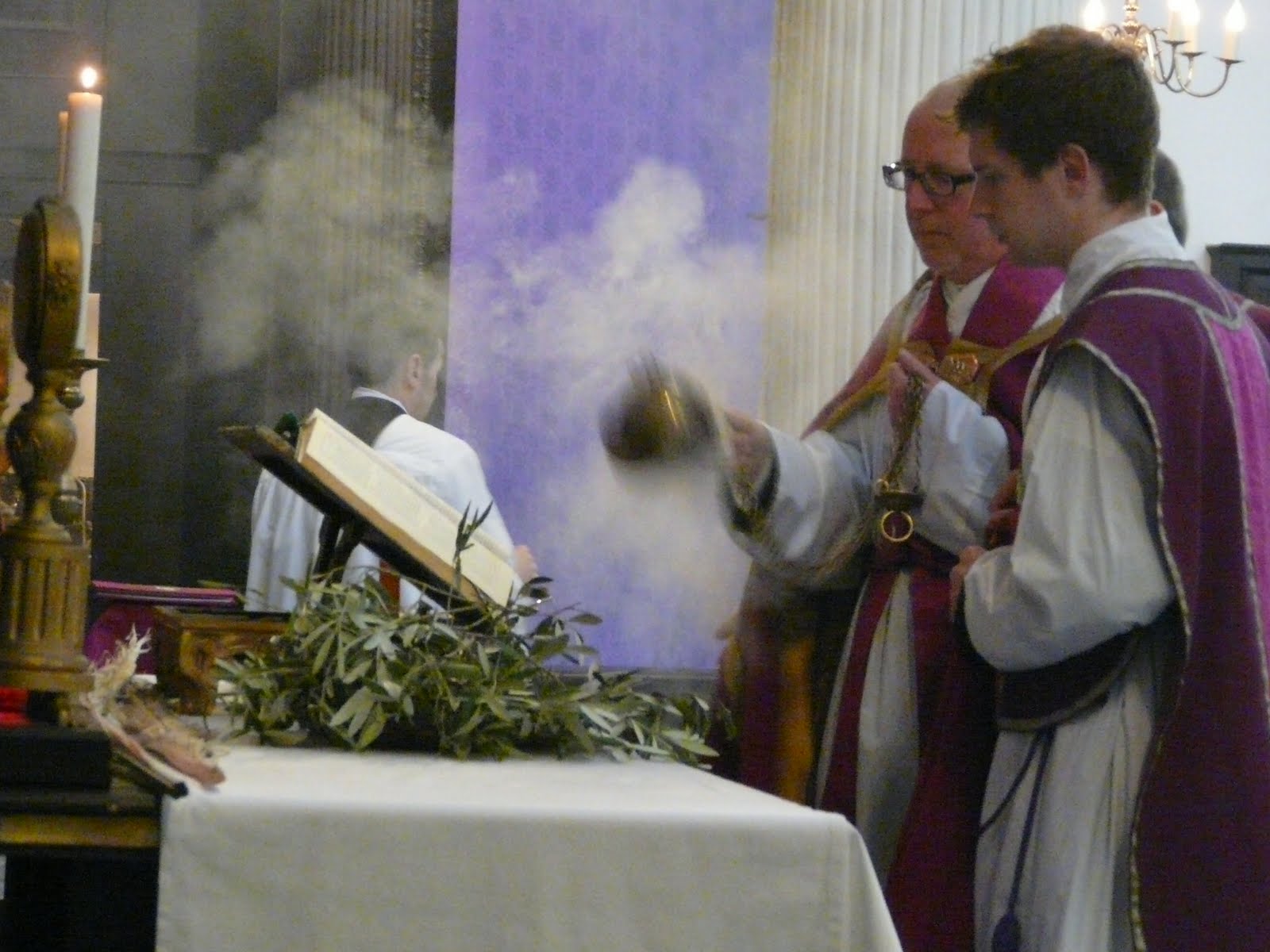
Here, the celebrant is seen censing the Elements. He has prepared a chalice of unconsecrated wine which also stands on the corporal. The Eucharist is censed, as is the altar but the Celebrant is not. He then says the Pray Brethren, not turning all the way, sings the Libera nos, performs the fraction and with some Communion devotions, receives the Host consecrated at Yesterday's Mass.


In deference to Local Custom, the faithful also receive Communion from a number of Hosts reserved with the Priest's Host.


There being no other ceremonies, the ministers stand to sing "When I survey the wondrous Cross" before retiring to the Sacristy.

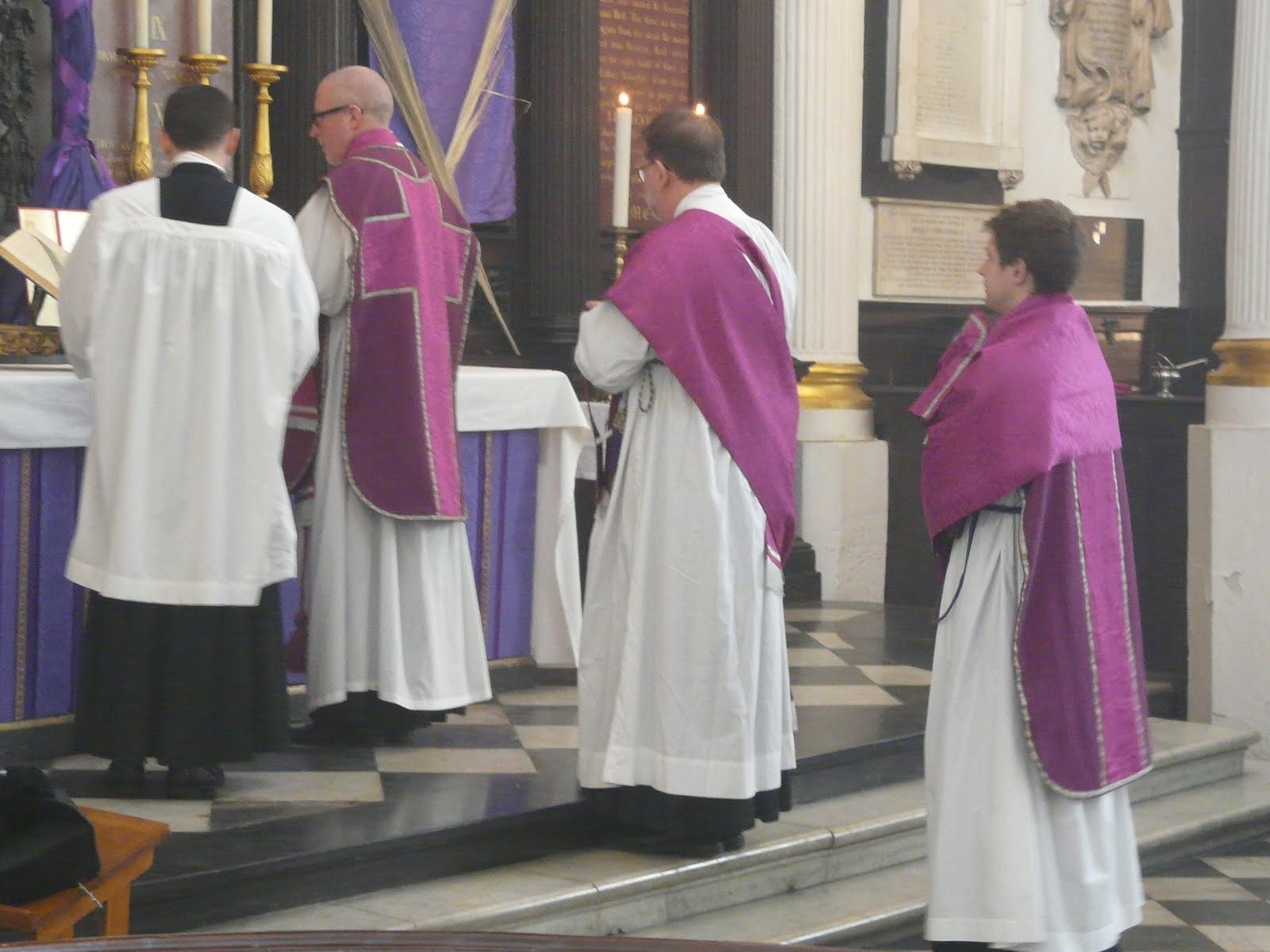
The ministers in the Sanctuary after the Liturgy

Monday, 29 March 2010

Palm Sunday in the pre-Pian rite


With no disrepect intended to the Venerable Pius XII, the Holy Week reforms that became effective during his pontificate truly make a dog's breakfast of the most important week in the liturgical year. I didn't quite realise how true that was until yesterday, when I assisted at a pre-Pian Palm Sunday for the first time, and realised why so many choose to cleave to this excellent tradition of liturgy. Not everyone will be familiar with the old-Old Rite rites, so I will try to describe the photos I have shared.

The blessing of the palms takes place within a ceremony that has the form of a little Mass, with its own Liturgy of the Word, Collects, Preface, Sanctus, and "Canon" of Blessing. This imitation-Mass clearly links the entrance to Jerusalem with the Passion that follows (in the Mass of the day). The vestments worn are folded chasubles for the Deacon and Subdeacon, and a cope for the Celebrant. The blessing and Mass both use purple, unlike the reformed rite instituted by Pius XII, and God only knows what happens in the Modern Roman Rite! In this picture the ministers arrive at the altar and move to the Epistle side.

Hosannah, Son of David is the Antiphon that corresponds to the Introit of a Mass, and at Oremus of the Collect, the Subdeacon goes to his place and removes his folded chasuble, before going to sing the Lesson from Exodus at the appointed place.

There is also a Gospel proper to the blessing, which recounts the entrance of Christ to the city. For this, the Deacon wears his broad stole as he would at Mass. The Celebrant is listening from the Epistle side, because the Missal has not been moved from the place of the Palms.


The Celebrant kisses the book and is censed as at Mass.

A preface follows, then a "canon" of five blessing prayers is said over branches of Olive and Palm.


The branches are lustrated and censed.

An assistant priest hands a palm to the Celebrant, and the ministers receive theirs kneeling.

Palms are then distributed to the faithful


The procession forms and leaves the church


The Subdeacon carries the veiled cross


When the procession arrives back at the church, two cantors remain inside and shut the doors. From inside they sing "all honour, laud and glory" which is repeated by those outside. After this dialogue, the Subdeacon strikes the door of the church thrice with the foot of the cross....


And the procession enters the church to the chanting of another Antiphon Ingredientem. As a side-bar, the piety of the women who chose to wear a Mantilla or a hat on this day is to be praised.


Mass proceeds as normal with the rules for Passiontide, except for the Chanting of the Passion, after which the end of the Passion is chanted as a normal Gospel, with incense (and acolytes but no lights) thereafter. Unfortunately I couldn't load the picture of the Celebrant, chanting the Passion as Christus at the Gospel side, while the narrator Chanted from the lectern.
This liturgy affected me in ways I didn't know it would. The sense of event which followed the first collect and reading, so familiar yet so different really caught my imagination. The silent, pregnant pause between the end of the Passion sung but the narrator, and the bit sung as the Gospel was truly dramatic and affecting. I have read that this climatic moment represents the desolation of the Church at the events described in the Passion. Even the slight pause that I made to genuflect while singing "and at the name of Christ...every knee shall bend" in the Epistle seemed appropriate, all leading up to the Great Event of the Eucharistic Sacrifice. I have rarely felt so free to engage with the Sacrifice as I did yesterday having heard the Passion sung. Hopefully I'll have time to post photos from the Triduum later this week. Stand by for a preview of our Good Friday vestments.


Tuesday, 10 November 2009

Liturgy of the Pre-Sanctified Gifts


For almost 55 years, the Western Church has been largely bereft of a Liturgy of the Pre-Sanctified gifts, a service which our brethren in the East celebrate during weekdays of Great Lent, and which in the Latin Church has long been restricted to Good Friday. Instead of the Celebration of Mass, a service in which Communion is received from a Host consecrated at a previous Mass still forms part of the Liturgy of Good Friday, but the reformed rites of Holy Week introduced by Pope Pius XII altered the Liturgy so radically as to make it something else entirely, and not a genuine Mass of the Pre-Sanctified, but rather similar to an order for Holy Communion outside of Mass.

In the pre-1955 rite, the Liturgy of the Pre-Sanctified begins after the adoration of the Cross, when the Blessed Sacrament is taken in procession from the Altar of Repose to the main altar carried by the Priest, and is censed by two acolytes. Although the origins are of course different, this procession mirrors the Byzantine Great Entrance procession, and it is worth noting that in the Eastern Pre-Sanctified services, on this occasion the priest, rather than the deacon carries the diskos holding the lamb. When the procession arrives at the altar, the deacon arranges the chalice. In the pre-1955 rite, a large second Host consecrated at the previous night’s liturgy is placed in a chalice, and covered by a pall, upturned paten and finally a soft, white veil, which is tied at the node of the chalice. The deacon leaves the chalice covered and arranges the veil over the chalice as at Mass. Indeed, the whole rite of the Pre-Sanctifies points to the celebration of a genuine Mass in structure and symbolism, whilst also quite clearly being something other than the Eucharistic Sacrifice. The priest at this stage censes the Sanctissimum.

The priest then slides the Host from the chalice, onto the paten which is held by the Deacon, and is then placed, with the chalice onto the corporal. The Deacon then fills the chalice with wine, and a drop of water is added by the Subdeacon, and it is placed on the corporal and covered with the pall, all as at Mass, except that all of the gestures and prayers of the Offertory are omitted. The Gifts are then censed as at Mass, as the cross and altar. However, nothing else, including the celebrant is censed. The presence of this chalice of unconsecrated wine is one of the most obvious analogies to the Byzantine rite, where a chalice is also prepared, veiled and censed at the prothesis, and at Communion, the Consecrated Lamb is placed in the unconsecrated wine in the chalice.

The priest says the prayer “In spiritu humilitatis”, then kisses the altar and says the “Orate frates”. The response “suscipiat” is, however, not said and the priest does not make a full turn at the altar as at Mass. This prayer makes the same plea for acceptance that marks the end of the Offertory at Mass, but without its response, the rite is altered markedly: the people do not pray for acceptance from "thy hands", seen as no Mass is being celebrated, and the references to "praise and glory" are absent. The central parts of the Sacrifice, the secret, preface, sanctus and canon are not said and the priest passes directly to “Oremus. Praeceptis salutaribus” and the Lord’s prayer, sung in the ferial tone. With the Sanctus go the words "pleni sunt caeli et terra gloria tua", on the very day when God divested himself of glory. The embolism is sung out loud and its accompanying gestures are omitted. This mimicry of the structure of Mass is not perculiar to Good Friday, but also appears in the Blessing of the Palms on Palm Sunday, which has a "Liturgy of the Word" and a "Canon" of blessings over the palms so laid on the altar. In both cases, these ancient rites were divested of this unique identity and made to represent the rites of blessings and communion respectively from ceremonies outside of Holy Week. The reference to the Paschal Mystery, the very pivot of these observances, is lost.

Then comes the elevation, and the Deacon and Subdeacon, who kneel on either side of the priest but slightly back, lift his chasuble. In place of the bell, the crepitaculum or clapper is used. The ministers rise, the chalice is uncovered and the fraction is performed, saying nothing and not making the sign of the cross. Then bowing, he says “Perceptio corporis tua” following the normal rite of his Communion at Mass and then communicates himself. He then consumes the unconsecrated chalice, but without the usual prayers or rites, as this is not the Blood of Christ. After his communion, the Priest makes the normal ablutions of the chalice and his hands and the Deacon re-builds the chalice as at Mass. It has been a long custom of the Roman Church for only the Priest to receive communion on this day, but in the Eastern Liturgy of the Pre-Sanctified, the people would also receive Holy Communion. The Church building itself is now empty of the Blessed Sacrament (Hosts for Viaticum being reserved in the Sacristy or another Altar or Building) which emphasises the sense of mourning at the Death of the Saviour on this day.

In the reformed rite of 1955, the Sacrament, in the form of a Ciborium of small Hosts, is brought to the Altar in Violet Mass vestments, by the Deacon (loosing the parallel with the Eastern Great Entrance), and incense is not used. The preparation of the Host on the corporal and the preparation of the chalice, incensation and washing of hands, as well as the prayers from the offertory are not performed. The introduction to the Lord’s prayer is said immediately, not sung as before, the Libera Nos is said by the Priest and then Perceptio is said silently. The priest communicates with a Small Host, and then Communion is given to all with the usual ceremonies of Mass. After Communion the priest makes his ablutions with vessels which were placed on the Altar for this purpose before the procession.

The simplification of the Communion rite of Good Friday eliminates both the parallels with the rite of Mass, and the analogies with the Byzantine Liturgy, both of which are integral to the identity of this rite. The reformed Holy Week makes the Communion no different from the distribution of Communion outside of Mass, such as would be given at a Wedding or for some other cause. With the reformed rite of 1955, the Western Church loses its one true Liturgy of the Pre-Sanctified. I wonder if the Communion rite was deliberately “rationalised” to bring it into line with other forms for Distribution of Communion, or whether it was simply intended to be shortened to make room for the prayers which follow afterwards. I wonder also if we will ever see aspects of the older rite re-emerge with the reform of the reform. Let’s wait and see.