Wednesday, 31 March 2010

April, the Month of the Blessed Sacrament


How appropriate that today, the first day of April, is both the first day of the month of the Blessed Sacrament, and the day of the Lord's Supper, when this Sacrament was instituted: God is clearly a liturgist. As many will know, Catholic piety assigns various devotions to specific months. Originally, certain devotions were given generous indulgences should they be made within a certain time, and gradually every month gained a devotional title to focus the piety of the faithful when no liturgical feast is being celebrated :

January: The Holy Name and Childhood of Jesus
February: The Holy Family
March: St. Joseph
April: The Blessed Sacrament
May: The Blessed Virgin Mary
June: Sacred Heart of Jesus
July: The Precious Blood
August: Immaculate Heart of Mary
September: Seven Dolours (Sorrows) of Mary
October: The Holy Rosary (and, less formally, the Holy Angels)
November: Poor Souls in Purgatory
December: The Immaculate Conception

Indeed, the twelve month cycle of non-liturgical devotion provides another set of squares in the rubiks-cube of the Christian year, which consists of a "dominical" cycle celebrating those movable feasts of the Passion, Resurrection and of Pentecost etc and the "sanctoral" cycle, which celebrates the Saints on fixed calender dates. Last week we saw how these two primary cycles can interact, when the Feast of the Annunciation, which is fixed on March 25th fell a day before the Feast of the Seven Sorrows, which is pegged to the Friday before Palm Sunday in the dominical cycle.

The devotional cycle adds another layer to the Christian year, and can bring us into a closer, more intense experience of the other, liturgical cycles. The devotional cycle demands of us personal, non-liturgical prayer, while the other cycles are about public, liturgical celebration or commemoration. The two are quite distinct, but at times their meeting can be a fruitful encounter for the soul. One common practice that was criticised in the early twentieth century was praying the Rosary during Holy Mass, and rightly so. In this case, there is no connection between what is happening at the altar and what is happening in the pew; there is no participio actuosa or "actual participation", as there was always meant to be, as the faithful "assisted" at the Sacrifice by praying it with their hearts and minds.

But where there is a connection, the public and private can fructify each other. From tomorrow, our private devotions will focus on the Eucharist, and our public devotion will be a re-enactment of the Passion of Our Lord, starting in the Upper Room and the Garden. As we enter into this Paschal mystery with devotion to the Eucharist on our hearts, we are able to seek in the Eucharist a deeper understanding and appreciation of the Passion, and vice-versa. As we make our preparation for our Paschal Communion, with that "sister Sacrament" of Holy Communion, Confession, we begin to grasp in our hearts the meaning of what's going around us in Church over the Paschal Triduum, and when we receive that Communion, which the Church advises we do, we truly become a people reborn.

Tuesday, 30 March 2010

The Seven Sorrows and Joys of S. Joseph


March is not over yet, and I haven't forgotten S. Joseph. One of the classic devotions to S. Joseph is that of his Seven Sorrows which also have seven corresponding Joys. Often they are prayed together on a Special Chaplet for this devotion which has seven large beads each followed by three Smaller ones. A meditation on the Joy and/or Sorrow is made on the large bead, and then followed by Our Father, Hail Mary and Glory be on the small beads. I'm trying to work out how to pray them on my new Servite Rosary of the Seven Sorrows of Mary but I'm not sure how. Ah, so many beads. Anyway, this is the devotion as described by CatholicCulture.org.

Two Fathers of the Franciscan order were sailing along the coast of Flanders, when a terrible tempest arose, which sank the vessel, with its three hundred passengers. The two Fathers had sufficient presence of mind to seize hold of a plank, upon which they were tossed to and fro upon the waves, for three days and nights. In their danger and affliction, their whole recourse was to St. Joseph, begging his assistance in their sad condition. The Saint, thus invoked, appeared in the habit of a young man of beautiful features, encouraged them to confide in his assistance, and, as their pilot, conducted them into a safe harbor. They, desirous to know who their benefactor was asked his name, that they might gratefully acknowledge so great a blessing and favor. He told them he was St. Joseph, and advised them daily to recite the Our Father and Hail Mary seven times, in memory of his seven dolors or griefs, and of his seven joys, and then disappeared.

(Recite one Our Father, Hail Mary, and Glory Be after each number)

1. St. JOSEPH, Chaste Spouse of the Holy Mother of God, by the SORROW with which thy heart was pierced at the thought of a cruel separation from Mary, and by the deep JOY that thou didst feel when the angel revealed to thee the ineffable mystery of the Incarnation, obtain for us from Jesus and Mary, the grace of surmounting all anxiety. Win for us from the Adorable Heart of Jesus the unspeakable peace of which He is the Eternal Source.

2. St. JOSEPH, Foster-Father of Jesus, by the bitter SORROW which thy heart experienced in seeing the Child Jesus lying in a manger, and by the JOY which thou didst feel in seeing the Wise men recognize and adore Him as their God, obtain by thy prayers that our heart, purified by thy protection, may become a living crib, where the Savior of the world may receive and bless our homage.

3. St. JOSEPH, by the SORROW with which thy heart was pierced at the sight of the Blood which flowed from the Infant Jesus in the Circumcision, and by the JOY that inundated thy soul at thy privilege of imposing the sacred and mysterious Name of Jesus, obtain for us that the merits of this Precious Blood may be applied to our souls, and that the Divine Name of Jesus may be engraved forever in our hearts.

4. St. JOSEPH, by the SORROW when the Lord declared that the soul of Mary would be pierced with a sword of sorrow, and by thy JOY when holy Simeon added that the Divine Infant was to be the resurrection of many, obtain for us the grace to have compassion on the sorrows of Mary, and share in the salvation which Jesus brought to the earth.

5. St. JOSEPH, by thy SORROW when told to fly into Egypt, and by thy JOY in seeing the idols overthrown at the arrival of the living God, grant that no idol of earthly affection may any longer occupy our hearts, but being like thee entirely devoted to the service of Jesus and Mary, we may live and happily die for them alone.

6. St. JOSEPH, by the SORROW of thy heart caused by the fear of the tyrant Archelaus and by the JOY in sharing the company of Jesus and Mary at Nazareth, obtain for us, that disengaged from all fear, we may enjoy the peace of a good conscience and may live in security, in union with Jesus and Mary, experiencing the effect of thy salutary assistance at the hour of our death.

7. St. JOSEPH, by the bitter SORROW with which the loss of the Child Jesus crushed thy heart, and by the holy JOY which inundated thy soul in recovering thy Treasure on entering the Temple, we supplicate thee not to permit us to lose our Saviour Jesus by sin. Yet, should this misfortune befall us, grant that we may share thy eagerness in seeking Him, and obtain for us the grace to find Him again, ready to show us His great mercy, especially at the hour of death; so that we may pass from this life to enjoy His presence in heaven, there to sing with thee His divine mercies forever.

Let Us Pray

O God, Who in Thine ineffable Providence has vouchsafed to choose Blessed Joseph to be the Spouse of Thy most holy Mother; grant, we beseech Thee, that we may deserve to have him for our intercessor in heaven whom on earth we venerate as our holy protector: Who lives and reigns forever and ever. Amen.

Monday, 29 March 2010

Exclusive Preview of Black Folded Chasubles


It is my pleasure to present the new set of Black folded chasubles for Good Friday made by Nick Sargent at S. Magnus the Martyr for this Holy Week. As you can see in the above photograph, we had decided to go for the Spanish cut of chasuble, and to fold them at the breast as one would a Roman chasuble. These are certainly the only Spanish-cut folded chasubles I have ever seen, most certainly unique in London and possibly in the UK.

This shot from the back shows the exquisite shape from the back, plus the effect given by the uniform single orphrey at the back. The contrast between the fine pattern of flowers on the chasuble fabric and the large, round cross-based motif is very pleasing. But these are not fussy vestments that distract the eye. Rather, they beautify the liturgy and contribute to a sense of solemnity which is entirely appropriate to Good Friday.

The orphrey fabric came from Damascus, from a supplier on Straight Street which has long had a friendly relationship with S. Magnus. Our purple High Mass set with dalmatics also features fabric from this shop. The orphrey pattern for this set features an anchor amidst circular crosses, a sign of hope for those who chose to discern it in the Passion which these vestments recall.


Here I am posing as a Deacon, although I think I can get away with it since it's just a photo-op. The broad stole features a band of the same purple as used on the maniples. The broad stole is also designed to cross over at the bottom to form the sort of "fish-tail" effect seen in other examples of the broad stole.


Palm Sunday in the pre-Pian rite


With no disrepect intended to the Venerable Pius XII, the Holy Week reforms that became effective during his pontificate truly make a dog's breakfast of the most important week in the liturgical year. I didn't quite realise how true that was until yesterday, when I assisted at a pre-Pian Palm Sunday for the first time, and realised why so many choose to cleave to this excellent tradition of liturgy. Not everyone will be familiar with the old-Old Rite rites, so I will try to describe the photos I have shared.

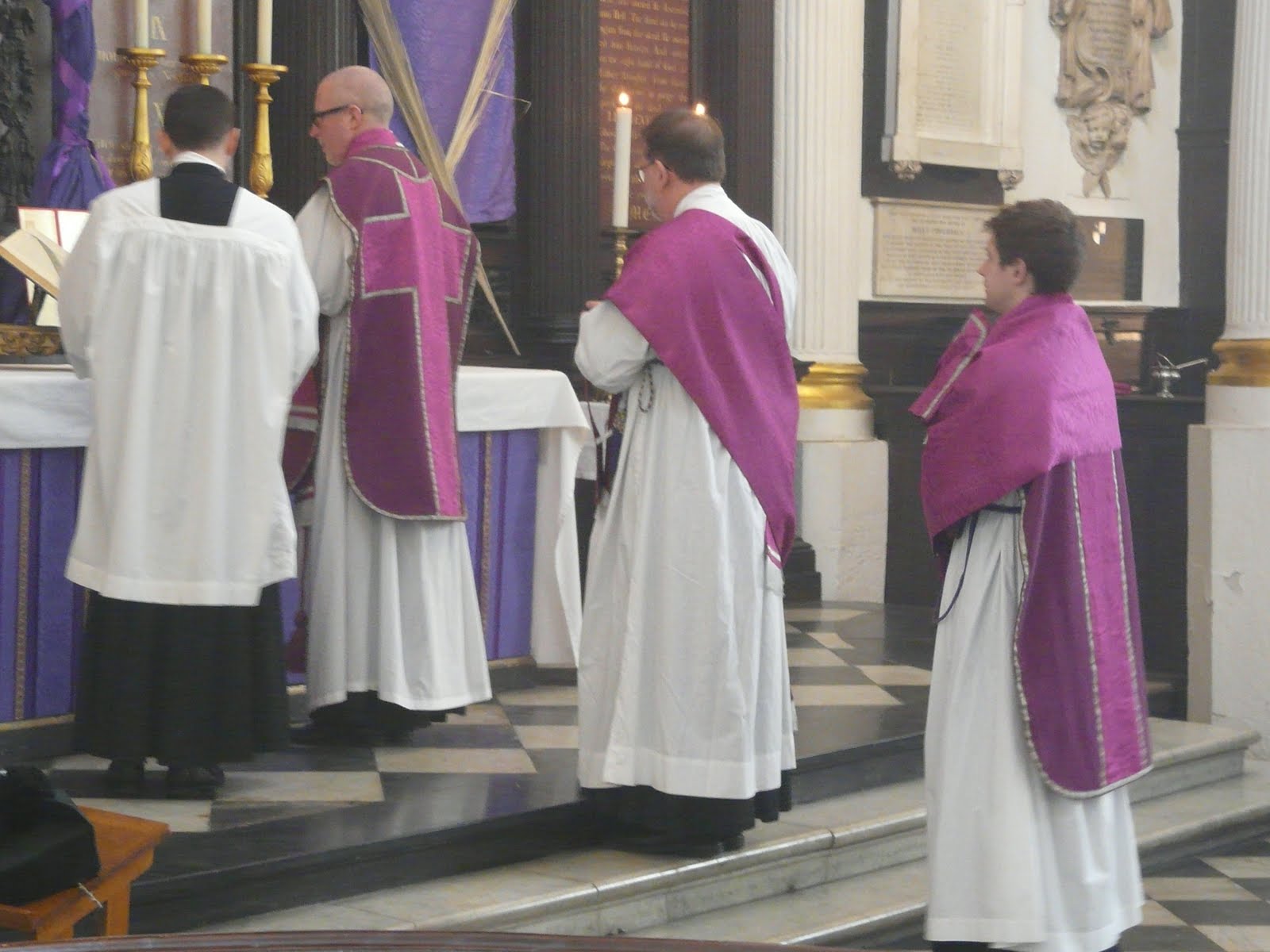
The blessing of the palms takes place within a ceremony that has the form of a little Mass, with its own Liturgy of the Word, Collects, Preface, Sanctus, and "Canon" of Blessing. This imitation-Mass clearly links the entrance to Jerusalem with the Passion that follows (in the Mass of the day). The vestments worn are folded chasubles for the Deacon and Subdeacon, and a cope for the Celebrant. The blessing and Mass both use purple, unlike the reformed rite instituted by Pius XII, and God only knows what happens in the Modern Roman Rite! In this picture the ministers arrive at the altar and move to the Epistle side.

Hosannah, Son of David is the Antiphon that corresponds to the Introit of a Mass, and at Oremus of the Collect, the Subdeacon goes to his place and removes his folded chasuble, before going to sing the Lesson from Exodus at the appointed place.

There is also a Gospel proper to the blessing, which recounts the entrance of Christ to the city. For this, the Deacon wears his broad stole as he would at Mass. The Celebrant is listening from the Epistle side, because the Missal has not been moved from the place of the Palms.


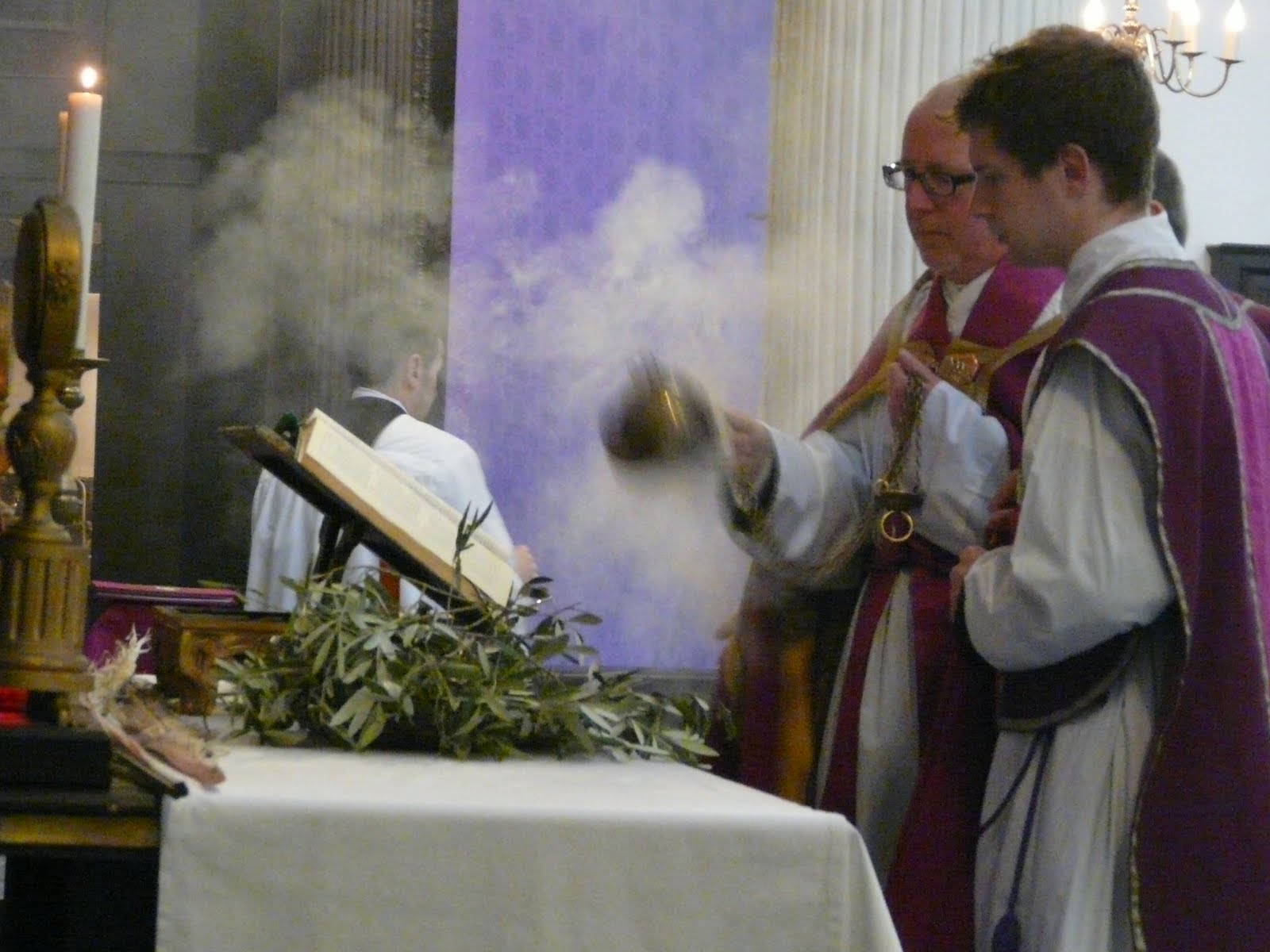
The Celebrant kisses the book and is censed as at Mass.

A preface follows, then a "canon" of five blessing prayers is said over branches of Olive and Palm.


The branches are lustrated and censed.

An assistant priest hands a palm to the Celebrant, and the ministers receive theirs kneeling.

Palms are then distributed to the faithful


The procession forms and leaves the church


The Subdeacon carries the veiled cross


When the procession arrives back at the church, two cantors remain inside and shut the doors. From inside they sing "all honour, laud and glory" which is repeated by those outside. After this dialogue, the Subdeacon strikes the door of the church thrice with the foot of the cross....


And the procession enters the church to the chanting of another Antiphon Ingredientem. As a side-bar, the piety of the women who chose to wear a Mantilla or a hat on this day is to be praised.


Mass proceeds as normal with the rules for Passiontide, except for the Chanting of the Passion, after which the end of the Passion is chanted as a normal Gospel, with incense (and acolytes but no lights) thereafter. Unfortunately I couldn't load the picture of the Celebrant, chanting the Passion as Christus at the Gospel side, while the narrator Chanted from the lectern.
This liturgy affected me in ways I didn't know it would. The sense of event which followed the first collect and reading, so familiar yet so different really caught my imagination. The silent, pregnant pause between the end of the Passion sung but the narrator, and the bit sung as the Gospel was truly dramatic and affecting. I have read that this climatic moment represents the desolation of the Church at the events described in the Passion. Even the slight pause that I made to genuflect while singing "and at the name of Christ...every knee shall bend" in the Epistle seemed appropriate, all leading up to the Great Event of the Eucharistic Sacrifice. I have rarely felt so free to engage with the Sacrifice as I did yesterday having heard the Passion sung. Hopefully I'll have time to post photos from the Triduum later this week. Stand by for a preview of our Good Friday vestments.


Thursday, 25 March 2010

The Annunciation


There must be something wrong with me; I just haven’t managed today to feel very spiritual about the Annunciation. Compared to the effort I put into the celebration of my Name Day last week, I feel like my efforts today have been entirely feeble. To be fair, it is my penultimate day in my current job, and so I’m mostly tying up loose ends in the office and saying goodbye to colleagues. The thought of serving as Subdeacon on Palm Sunday (and having two epistles to chant!) is playing on my mind, as I must remember to revise the rubrics for that day. Holy Week and the desperate need for some quiet time before the Sacred Triduum is similarly looming over my waking hours and stressing me out mildly. I woke up this morning, said my prayers and my novena devotions to S. Rita of Cascia for my grandmother’s health (!), but despite the short time I’ve offered to God in prayer today; I feel that between myself and the mystery of the Incarnation is an unfathomable spiritual distance that frustrates me and leaves me feeling, well, disappointed.

I don’t know what I should do, but I have a good idea of what I’m going to do. Before or after Mass today, I will try to spend some time in quiet prayer before the Blessed Sacrament and I will try to pray the Joyful Mysteries of the Holy Rosary, because that is where we are promised a way into the boundless mystery of the Incarnation which we celebrate today. The Eucharist is that sacred rite in which the entire redemptive act, which begins to play out at the Annunciation, is made present to us. The Mass brings together every line of the story, from Annunciation to Presentation, to Passion to Crucifixion to Resurrection, bringing the bookends of the narrative together and fusing these moments into one. In the shadow of these other events, especially of the Passion and Death of Christ, the Annunciation begins to round-out, and we see it for what it is, a Holy Mystery, as unfathomable as all the others, but comforting, meaningful; the manifestation of a Love that knows no bounds. We see Mary’s fiat, in which the exuberance of love for God that she had been storing up in her Immaculate Heart, suddenly overflows, only to be replaced by the bitter grain of Simeon’s prophecy, and ultimately the sword that pierced that same innocent heart at the sight of her Son and Lord crucified.

Our comfort and our joy, on the feast of the Annunciation, is to participate in that bitter-sweet sacrifice of Mary’s “yes” by receiving Jesus into our souls in Holy Communion, and nurturing Him there as Mary did in her womb. Mary’s sacrifice is joined to Christ’s, as it is so often said; one could not happen without the other. No matter how lazy or unmoved I feel today, I know that in the Blessed Sacrament I will receive the grace to dive into that Mystery and dwell there for as much as my soul can bear, and that I will be sharing in Mary’s sacrifice, which begins today with her joy at the Annunciation, and is completed tomorrow when her Heart is pierced by the last of her Seven Sorrows.

For readers in London, there will be a Low Mass with Cantor at S. Magnus the Martyr at 6pm. You will be very welcome to join us there.

Monday, 22 March 2010

Passiontide

Passiontide veiling in the church of Ss. Trinita, Rome, from the New Liturgical Movement


For a long time I didn’t actually know why we veiled images in the church during this portion of Lent we call Passiontide. I thought it was probably the beginning of that process of stripping away adornments and creating an impression of shocking starkness in the space where heaven meets earth, a process which reaches its zenith on Good Friday, when we see the altar bare and unadorned, suddenly so much like a sepulchre, or the empty hill upon which the Cross will soon be raised.

This Sunday however, in looking over the readings of Mass in the Roman tradition, I read that the meaning behind this custom of veiling is found in the Gospel reading. After answering to the accusations of blasphemy made by the Jews, and in the midst of an attempted stoning, Our Lord does something simple and almost obvious but redolent with importance. “Jesus hid himself, and went out of the temple”. Our Lord, the King of Heaven, went away and hid himself to those around him.

In S. Magnus on Sunday, we heard a different reading from the Gospel, the story of the woman taken into sin who was to be stoned. “Let he who is without sin cast the first stone” says Our Lord, calling those around Him to self-examination, and the realisation of their own hypocrisy. All they can do, on reflecting momentarily on the enormity of their own sins, is walk away. In this story too, we find Jesus hidden. In the middle of this episode, in which He teaches us so much with so few words, He is still mysteriously writing in the dust, tracing words which are hidden to the Gospel-writer and the crowd, and hidden to us.

We know that before the agony of His Passion, which started with the first realisation of what was to come, Jesus went away to fast and to pray. When we in Lent prepare ourselves by prayer and fasting, we are sharing in Our Lord’s own preparation, and in Passiontide we do so more by following Christ into our own hiding place. Under the purple veil of penance, we are taken into a face-to-face encounter with ourselves, and an intensive process of self-examination begins. The Prince of Glory on the crucifix is hidden to us, as also is the glory of heaven, represented by His saints. Now we are being called into a time of hiding with ourselves, a time of honest self-encounter, of penance and decision. In Passiontide we veil ourselves and hide ourselves away to be transformed by prayer, and to be like the One who came to save us.

Thursday, 18 March 2010

Happy Feast of S. Joseph


Since first Vespers have been said already, it's time to wish everybody a Happy Feast of S. Joseph. May the Foster-father of Christ, the Terror of Daemons, be your protection. May the Light of Patriarchs bring to you the light of Holy Wisdom, and may the most chaste spouse of the Blessed and Glorious Ever-virgin Mary be your intercessor in heaven before the throne of the Almighty.

Ite ad Joseph! Go to Joseph, because he is always awaiting your prayers and petitions. Just as Christ never failed in obeying his earthly father, so in heaven too he cannot but grant the requests made by Joseph on your behalf.


Sancte Joseph, Ora Pro Nobis!